After completing the twelve trials, Hercules became the most admired hero in all of Greece.
However, his life after freedom made him feel an indescribable emptiness. He had had a family – a beautiful wife Megara, lovely children – but that was all destroyed in the madness descended upon by Hera. Now that the trial is over and his sins have been washed away, he longs to start over, build a new family, and have a new life.
So when he heard that King Eurytus of Oicalia was holding an archery competition for his daughter Iole, and the winner could marry the princess, Heracles was moved.
Oikalia is a wealthy and beautiful city-state located in the Thessaly region of central Greece. King Eurytus was one of the best archers in Greece. It is said that his grandfather was Apollo, the sun god, and the skill of bow and arrow ran in his blood. He had several sons who were also proficient in archery. The eldest of them was Iphitus, an upright and kind-hearted young man.
And Princess Iole is the pride of the entire kingdom. Not only is she beautiful, she also has a gentle temperament and a smart mind. Countless princes and heroes came to propose marriage, but Eurytus had only one condition: “Only the one who defeats me and my sons in an archery contest is worthy of my daughter.”
This condition sounds almost impossible to fulfill, because the Eurytus family’s archery skills are unmatched in the world, and no one has ever been able to defeat them.
But Hercules decided to try.
On the day of the game, the square in Oikalia was packed with people.
The participating warriors took the stage one after another and shot towards the bullseye in the distance. Some people hit the edge of the target, some missed the target, and some couldn’t even draw the string of the strong bow Eurytus prepared. Eurytus and his sons sat on the high platform, with confident smiles on their faces, watching these challengers fail one by one.
Then came the turn of the sons of Eurytus.
The eldest son Iphitus was the first to step on the scene. He drew his bow and the arrow flew out like a meteor, hitting the target. The crowd erupted in cheers. Then came the second son Clytius and the third son Toxius, each of them hit the bullseye, and every arrow was extremely accurate.
At last Eurytus himself stood up.
Although the old king is old, his figure is still upright. He drew his bow and the arrow flew out. Not only did it hit the bull’s-eye, it even split the arrows shot by his sons in two. The crowd fell into a dead silence, then erupted into even louder cheers.
Eurytus turned to face the crowd and said proudly: “Who else dares to challenge?”
“I.”
A deep voice sounded from the crowd. The crowd made a way, and Hercules strode out.
He was wearing a lion skin and carrying a huge bow on his shoulders. The ground seemed to be shaking slightly with every step he took. When Eurytus saw him, the smile on his face froze.
“Hercules,” the king said slowly, “what are you doing here?”
“Enter the contest,” Hercules said quietly, “and win your daughter’s hand.”
Eurytus was silent for a moment, then said: “You know the rules. Defeat me and my sons, and Iole will be yours.”
Hercules nodded and moved to shooting position.
He drew his bow.
It was a huge bow that ordinary people could not even pull open, but in Hercules’ hands, it was as easy as a toy. The bowstring was taut, making a low buzz, like a wild beast roaring.

The first arrow was shot.
The arrow pierced the air, making a sharp whistling sound, hitting the bull’s-eye, embedded deeply into the wood, and the entire target trembled.
the crowd exclaimed.
Heracles did not stop. He shot the second, third, and fourth arrows in succession. Each arrow accurately hit the same position, shattering all the previous arrows. The last arrow even penetrated the target and was nailed to the stone wall behind.
There was silence in the square.
Everyone’s eyes widened and they looked at the scene in front of them in disbelief. Eurytus turned pale, and his sons looked at each other, speechless.
Hercules lowered his bow and turned to face Eurytus, “I win.”
However, Eurytus did not answer immediately.
He stood on the high platform, looking at Hercules, with complex expressions flashing in his eyes – shock, awe, and fear. He took a deep breath and said slowly: “Hercules, your archery skills are indeed unrivaled. But… I cannot marry Iole to you.”
The crowd fell into dead silence again.
Hercules frowned, “You promised that the winner could marry the princess.”

“I know,” Eurytus’s voice trembled, “but I also know your past. You killed your first wife Megara, and your children. It was not your fault, it was the madness sent by Hera, I understand. But…” He paused, his voice became firmer, “I can’t take this risk. I can’t let my daughter, and her future children, face the same fate.”
Hercules’s face darkened, “You are breaking your promise.”
“I am protecting my daughter,” Eurytus said, with a hint of pleading in his voice. “Please understand, Hercules. You are a great hero, but you are also a cursed person. I can’t…I can’t let Iole take this risk.”
Hercules didn’t speak, he just stared at Eurytus, his fists clenched and veins bulging. The air in the entire square seemed to freeze, and everyone held their breath, waiting for the hero’s reaction.
Finally, Hercules took a deep breath, turned and left.
But the moment he walked out of the square, he turned back and said in a cold and calm voice: “One day, Eurytus, you will pay the price for today’s decision.”
Heracles left Oicalia, burning with rage and humiliation.
He won the contest but was denied the reward. He knew that Eurytus’s concerns were not unreasonable – he had indeed killed his wife and children in madness – but the shame was still like a sharp knife piercing his heart.
However, fate has not let him go yet.
A few days later, Eurytus’ twelve horses mysteriously disappeared. Some say that Hercules stole it, while others say that the thief Autolycus stole it and sold it to Hercules. There are different opinions. The sons of Eurytus searched separately, but only the eldest son Iphitus firmly believed that Heracles was innocent.
Iphitus went to Heracles and asked for his help in finding the horses. Hercules was grateful for the young man’s trust and invited him to his residence in Tiryns.
That day, the two of them walked on the palace wall, talking about the whereabouts of the horses, life and destiny. Iphitus was a kind and upright young man. He sincerely said to Heracles: “I believe you are innocent. My father was wrong to reject you, but he was just afraid of losing his daughter. Please forgive him.”
Heracles was silent for a long time, and then said: “You are a good man, Iphitus. You are not prejudiced like your father.”

However, at this moment, there was a burst of ridicule from somewhere, as if someone was laughing at Hercules’ failure and humiliation. The sound might be the sound of the wind, the chirping of birds in the distance, or it might just be an illusion in Hercules’ mind.
But at that moment, something dark awoke in Hercules’ heart.
Hera’s curse never really left him.
Hercules’s eyes suddenly became empty. He turned around and looked at Iphitus standing on the edge of the city wall. A crazy idea flashed through his mind – this man was the son of Eurytus, a member of the family that humiliated him.
Before Iphitus could react, Hercules reached out his hand and pushed him out violently.
Iphitus screamed in terror, fell from the towering city wall, hit the rocks below, and died on the spot.
When Hercules came to his senses and saw the broken body of Iphitus lying in a pool of blood, he fell to his knees and let out a heart-rending roar.
He killed again.
Not an enemy, not a monster, but a friend who believed in him, helped him, and treated him well.
Hercules was put on trial. The gods decreed that he must pay for this crime by serving Omphale, Queen of Lydia, for three years as a slave to atone for his sin.
Those three years were the most humiliating time in Hercules’ life. Queen Omphale made him wear women’s clothes, weave with the maids, and serve her like a servant. But Hercules endured everything silently, because he knew that this was the punishment he deserved.
Three years later, Hercules was finally free.
He left Lydia and went to Calydon, where he met Deianira, sister of Meleager. He fought with the river god Achelous and won her heart. The two got married, had children, and lived a peaceful life.
The matter of Yiole seems to have become a distant past.
But once the seeds of hatred are planted, they will slowly take root and sprout in the soil of time.
Many years later, Heracles was a mature middle-aged hero. Deianira gave birth to several children for him, and his family life seemed happy.
However, one day, when Hercules passed near Oicalia, he remembered the archery competition, the treachery of Eurytus, and the death of Iphitus. Those memories were like old liquor, getting stronger with time, igniting the flame of revenge in his heart.
He returned home and raised his army.
Deianira felt uneasy as she watched her husband prepare to go to war. “Where are you going?” she asked.
“To complete something that was left unfinished many years ago,” Hercules said, a cold light flashing in his eyes.
Deianira asked no more questions, but her heart sank.
Heracles led a large army and surrounded Oicalia.
Eurytus was already a gray-haired old man, and his sons had grown up and became the guards of the city-state. But no matter how superb their archery skills were, they could not withstand the wrath of Hercules.
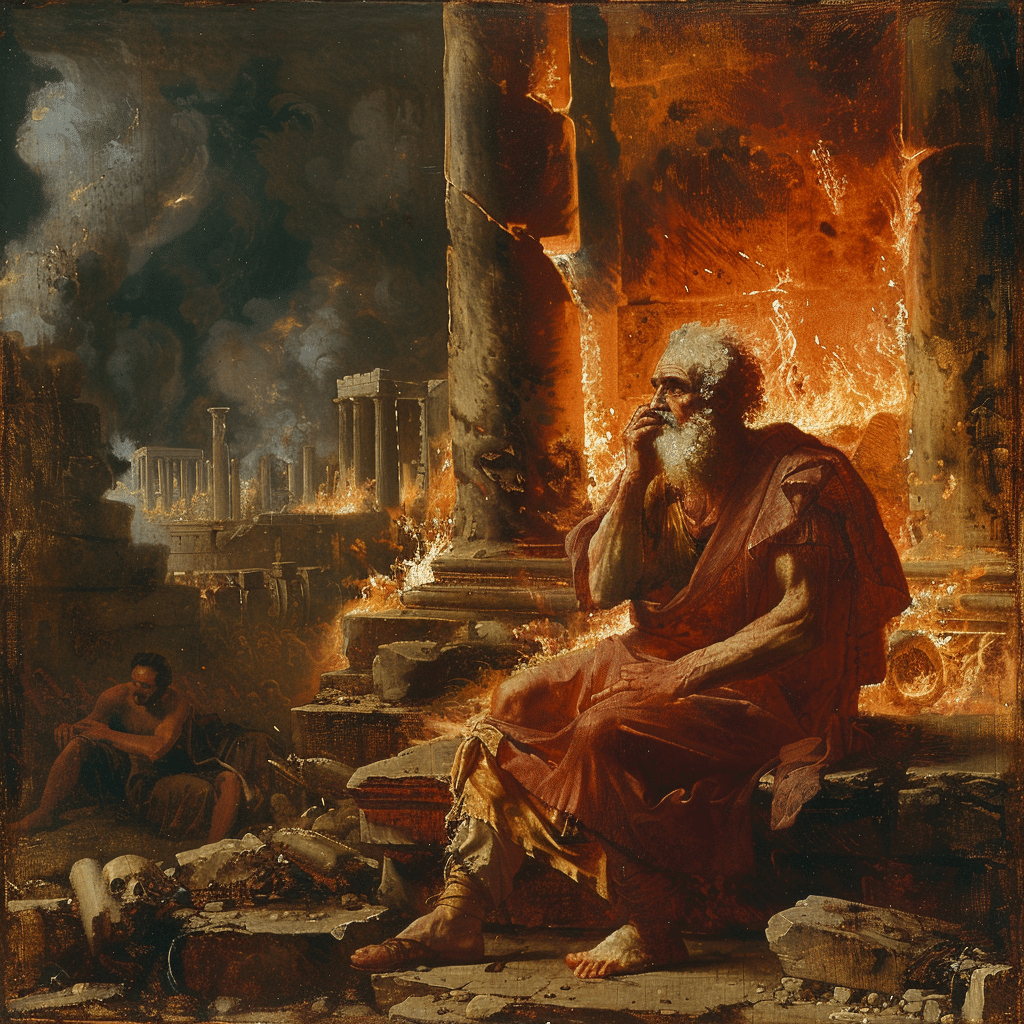
The fighting lasted for several days. The walls were breached, the defenders routed, and Oicalia was in flames.
Hercules stood in front of the burning gate, watching Eurytus and his sons make their last stand. The once proud king was now in a sorry state, with despair on his face.

“Heracles,” Eurytus gasped, “please spare my city, spare my people.”
“You have denied me the reward I deserve,” Hercules said coldly. “Now, I have come to take back what is mine.”
Having said this, he swung his club, and Eurytus and his sons fell down one after another.
After the battle, Hercules found Iole among the ruins.
She is no longer the girl she once was, but a mature woman, but still beautiful. She looked at Hercules with no fear in his eyes, only deep sadness.
“You’re finally here,” she whispered. “You killed my father, you killed my brother, you destroyed my home. Did you get what you wanted?”
Hercules didn’t answer. He just ordered that Iole be taken as a trophy.
When Hercules returned home with Iole, Deianira stood at the door to greet him.
She saw the beautiful woman behind her husband, saw the complicated expression flashing through Heracles’s eyes, and understood everything in her heart instantly.
“Who is she?” Deianira asked, her voice eerily calm.
“Iole,” said Heracles, “Princess of Oicalia. My… trophy.”
Deianira did not speak, she just looked at her husband quietly, and then at the beautiful young woman, feeling an emotion that she had never experienced before.

It was not anger or sadness, but a colder, more desperate fear.
She was afraid of losing Hercules.
She was afraid that this family, these children, everything they had worked hard to build over the years would collapse because of this woman.
That night, Deianira couldn’t sleep.
She thought of the man Manesus she met by the river many years ago. The centaur who told her before he died that his blood could be used to make a love potion that would make Heracles loyal to her forever.
She took out the bottle of blood that had been stored for many years from the depths of the cabinet, looked at it, and felt a war between heaven and man in her heart.
Perhaps, with a little smear on Hercules’ clothes, he would fall in love with her again and forget about the young princess.
Maybe, everything will return to normal.
Deianira didn’t know that the bottle of blood was mixed with the poison of the nine-headed water snake.
She didn’t know that she was about to cause an irreversible tragedy.