In distant ancient Greece, there was a girl named Arachne. Her fingers were as nimble as the wind, and the cloth she weaved was so beautiful that even the gods were amazed. However, there is a pride hidden in her heart that refuses to bow, causing her to embark on a road that no one has ever traveled – at the end of that road, waiting for her is a duel that changes her life, and a mystery that can never be solved.

The girl who lives in the dye house
There is a small city on the Aegean Sea called Hypaepa. The streets in the city are not wide and the houses are not high, but every evening, there is always a strange aroma floating in the air – it is the smell of wool soaked in dye, with a bit of grass fragrance and a bit of earth warmth.
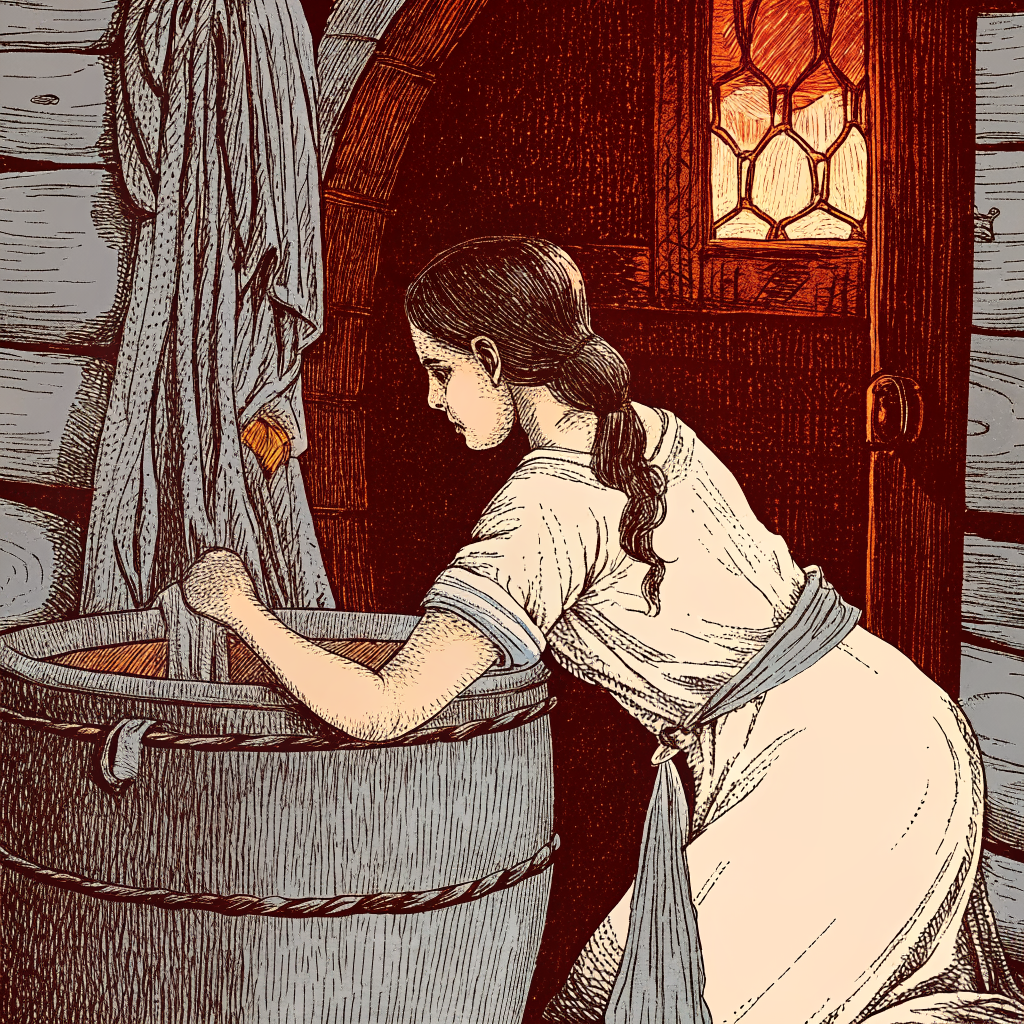
This fragrance comes from a small dyeing workshop near the city. The owner of the dyeing shop is a man named Idmon. He is the best dyer in the city. He knows how to use madder to dye bright red, boil conch shells to make precious purple, and use gorse to make brilliant yellow. His dye barrels are arranged neatly in rows in the yard, like a colorful lake.
Edmund had a daughter named Arachne.
Arachne liked to sit on her father’s lap since she was very young, watching the silk threads being dyed, turning from gray to brilliant bit by bit. Her eyes were round, like two black grapes. She stared at the dye vat so fascinated that she often forgot to eat.
The color seemed to run away from Arachne. She was afraid of missing every moment – the second when the wool was lifted, the way the color blurred from dark to light, the small rainbow reflected when water droplets slipped from the silk thread.
When she was older, she began to pick up shuttles and wooden frames herself and try to weave those colors into the fabric. At first, she knitted very ugly. The shuttle kept getting stuck, the threads were knotted, and the knitted patterns were crooked, which made her stamp her feet in anger. But she didn’t give up. She did it over and over again, her fingers getting red marks from the thread, but she didn’t care and continued knitting.
In this way, one year has passed, two years have passed, and three years have passed.
Arachne’s fingers became more and more dexterous, as fast as the wings of a hummingbird. Her cloths are becoming more and more beautiful, so beautiful that neighbors stop and travelers take a long detour to take a look. Some people say that the sea she weaves makes people want to jump into it more than the real sea. Some people say that the flowers she weaves are more fragrant than those in the garden. Of course, the flowers in Brie are not fragrant, but that’s what people who look at them think.

Fame has transcended mountains and seas
When Arachne was fourteen, her fame spread not only in the city of Hippa, but also spread across the mountains, across the rivers, and even across the Aegean Sea to far away places.
People came from all over just to watch her weave. They crowded in the yard outside the dye house, standing on tiptoes, poking their heads, holding their breath, as if they were watching a magical magic show. Arachne sat in front of the loom, her back straight, her head slightly lowered, her fingers moving between the threads, quickly and accurately, never hesitating. The shuttle flew over with a “swish” sound, and then flew back with a “swish” sound. Every time it fell, a new pattern appeared on the cloth.
She could weave a galloping horse whose mane looked like it was blowing in the wind. She can weave the starry sky at night, and the light of the stars is outlined with silver thread, making it look like they are really twinkling. She can weave waves, layer upon layer, intertwined with blue and green, making people feel like they are standing on the beach.
Everyone who saw it said, “This child’s hands must be given by God.”
Arachne would frown slightly every time she heard this sentence.
“Given by God?” she thought to herself, “I practiced it myself. I started over again and again, endured the pain in my hands and continued to weave. I figured out every technique by myself. What does this have to do with God?”
She didn’t say it out loud, but the idea became clearer and louder in her mind. Gradually, some people began to ask her directly: “Arachne, your skills are so good, did the goddess Athena teach you?”
Athena is the goddess on Mount Olympus. She is in charge of wisdom and craftsmanship. It is said that she is the patron saint of all weavers. It is she who brought the art of weaving to mankind.
Arachne raised her head, looked at the questioner calmly, and said, “No. I learned my skills myself. If Athena really wants to compete with me, I will not back down.”
This sentence is like a stone thrown into water. The ripples spread out in circles, spreading farther and farther.

Old woman’s warning
A few days after that sentence spread, a strange old woman came outside the dyeing workshop.
She walked a little slowly, her back was a little hunched, she was holding a wooden stick in her hand, and her head was wrapped in a gray cloth. She stood outside the yard and looked at the busy Arachne. She was silent for a long time before she said, “My child, I heard that you wanted to compete with the goddess Athena in weaving?”
Arachne didn’t even raise her head and continued to move her fingers: “Yes.”
“Aren’t you scared?” The old woman’s voice was very soft, like the sound of wind blowing through leaves.
“What are you afraid of?” Arachne stopped the shuttle and looked at the old woman. “If my skills are really good, then it is worth telling. If the goddess is really better than me, I will admit defeat and be convinced. But if I am better…” She paused, “Then I am just telling the truth.”
The old woman looked at her quietly, with an indescribable light in her eyes. She sighed and said, “Child, pride and self-confidence are different things. Confidence makes you walk steadily, but pride may make you fall. The wrath of the gods is not something that people can easily bear.”
Arachne frowned. She wasn’t a bad-tempered person, but she didn’t like being told to back off either. “Mother-in-law,” she said, “I respect you, but I will not take back what I said. If it was a lie, I should take it back. But it is not a lie.”
The old woman was silent for a moment.
Then, something strange happened.
The hunched figure suddenly straightened up. The gray fabric slipped away, revealing a shining robe, with patterns as delicate as a thousand threads intertwined. The old woman’s face changed, the wrinkles disappeared, and her eyes became clear and deep, like a bottomless lake. Behind her, the shadow of an owl appeared vaguely, spreading its wings silently.
Arachne froze. All the people in the yard were stunned.
Standing in front of them was the goddess Athena herself.
“You have heard the warning,” Athena’s voice was calm, but there was a weight that no one could ignore, “Now, are you still willing to compete?”
Arachne’s heart was beating fast. She felt that her legs were a little weak and her palms were a little sweaty. But she took a deep breath and steady herself.
“Yes,” she said.

loom to loom
The news spread, and the whole city of Xipapa was boiling. People came from the street, from the shop, from the field, and surrounded the yard of the dye house. The children climbed up the wall, the old people moved chairs, and even the blacksmith, who was usually the most lazy to go out, patted the dust on his apron and walked over quickly.
Two looms are placed side by side in the center of the courtyard.
One was used by Arachne on a daily basis. The wood had been polished smooth by her hands, and there were still faint traces of dye on it. The other one was brought by Athena. It looks very ordinary, but if you look closely, the grain of the wood seems to be flowing slowly, as if it is alive.
“Let’s begin,” Athena said.
They both sat down at the same time and picked up the shuttle.
What Athena weaves is the story of the gods. Mount Olympus appeared on her canvas, with clouds and mist on the top, and twelve gods sitting on their seats, majestic and majestic. Zeus holds lightning, and Poseidon holds a trident. The faces of each god are clearly distinguishable, and their expressions reveal inviolable majesty. She also weaved a small pattern in each of the four corners. They were four people who did not know the heights of heaven and earth, challenged the gods and were eventually punished. They were used to remind viewers that the status of gods cannot be doubted.
Athena’s technique was smooth and flowing, with gold and silver threads weaving between her fingers. The patterns on the cloth seemed to really shine, making onlookers squint their eyes.
But Arachne was not far behind.
What she weaves is a story about the gods, but a different version.
On her canvas, Zeus transformed into a white bull and carried away Europa. She weaves Zeus in the form of a swan visiting Leda. She weaves gods down to earth again and again, disguised in various guises, and doing all sorts of surprising things. Every one of her stories is a true story that is spread among people, and not one of them is fabricated by her.
Her lines are extremely smooth, the colors transition seamlessly, and every color is so connected that you can’t find the seams. The characters have rich expressions and vivid movements, and the characters on the canvas seem to be moving in the next second.
The crowd of onlookers was silent.
No one dared to speak loudly, no one even dared to breathe loudly. They just watched, watching the two looms operating at the same time, watching two completely different stories slowly taking shape on the cloth.
The sun climbs from the east to the top, and then slides from the top to the west.
Neither of them stopped.
Finally, in the last ray of light at dusk, the two cloths were completed at the same time.

truth on paper
Athena stood up, walked to Arachne’s cloth, and looked at it carefully for a long time.
The courtyard was so quiet that you could hear a pin drop.
Arachne’s cloth is impeccable. The technique is perfect, the composition is bold, and every line falls where it should. The color combination is bold and harmonious, and the whole cloth exudes a strange vitality, which makes the viewer want to get closer and reach out to touch whether the waves on the cloth are really wet and whether the flames on the cloth are really hot.
Technically speaking, it is not inferior to Athena’s cloth.
This was a result that no one expected, including Athena herself.
But Athena’s eyes stopped at the content of the stories on the cloth. Zeus transformed into a bull, and Zeus transformed into a swan. The gods teased and deceived mortals again and again, appearing in the world with various faces and doing things that gods should not do. Arachne had woven all of this into the fabric, stitch by stitch, clearly and without concealment.
That’s not a lie, every story is a true myth.
But weaving them out in such a grand manner is like spreading the most disgraceful appearance of the gods in front of everyone, and it is like saying: the gods you worship are actually like this.
Athena’s eyes changed.
She stretched out her hand, and before anyone could react, her hand touched Arachne’s cloth, and then – the cloth that took a whole day of hard work to complete, split from the middle, a gap from top to bottom, splitting the carefully woven stories into two, and then continued to split, and continued to split, until the entire cloth turned into pieces and fell to the ground.
Arachne was stunned.
She looked at her day’s hard work scattered into pieces of color on the ground, her throat seemed to be blocked by something, and she could not speak. Her hand still maintained the position of holding the shuttle just now, slowly spreading it out, and then slowly holding it again.
Then Arachne cried.
Not because she lost, because she knew she didn’t lose.
She cried because that piece of cloth contained all of her strength, all of her seriousness, all of her, and those just disappeared.
She stood up, turned around and walked into the dyeing workshop. She walked to the shelf where the raw materials were placed and took off a thin rope.
She wanted to end it all.
Athena arrived in time, grabbed her arm and pulled her back hard. At that moment, a complex emotion flashed across the goddess’s eyes. It was not pure anger, but mixed with something that was harder to explain clearly.

The punishment of the goddess and another life
“You’re not going to die,” Athena said, her voice lower than before, “but you can’t just live like this.”
Her hand gently touched Arachne’s forehead.
At that moment, the light in the dyeing workshop seemed to be distorted, like a stone thrown into the water, and the ripples spread outward. Arachne felt her body begin to become lighter, and then became even lighter, so light that she seemed to disappear. She looked down at her hands—the hands she treasured most—only to find that they had gotten smaller and thinner, and then continued to change, and continued to change, from two hands to four, from four to six, and finally to eight.
Her body shrank, shrinking into a shape she never thought she would have.
Everything around became huge. The wood grain of the floor was like the ridges of mountains, and the dust floating in the air was like stars in the sky. Every corner that she had never noticed before now became clear and grand.
Arachne turned into a spider.
But one thing hasn’t changed.
There were threads in her belly. An endless stream of silk.
She tried to stretch out those eight thin legs – no, it would take some time to get used to it. She tried to move first, trying to feel the weight and balance of this new body. Then she tried to pull the silk out.
That feeling was strangely familiar.
It felt like she was holding the shuttle and letting the thread pass between her fingers.
She began to knit.
Not because someone ordered her to, not because she wanted to prove something, but just because that was the way she was, and as long as there was thread in her hands – whether it was two or eight – she would start weaving.
She started from the corner of the dyeing workshop, pulled out the first silk thread, fixed it in the corner, then walked, brought the thread over, fixed it again, walked again, and fixed it again. One after another, one after another. The net slowly took shape in the dark. Every intersection was precise, every spacing was even and neat, and the entire net was symmetrical like a carefully designed work of art.
The first ray of light in the morning passed through the window slit of the dyeing workshop and shone on the newly completed spider web. The light refracted on each thread and turned into seven colors, shining brightly in the darkness.
It was the first web Arachne weaved, and the first work in her new life.

The thread never stops
From that day on, people began to discover something strange.
Whether it is in a barn in the field, in the corner of a fishing boat, or between the stone pillars of a temple, you may find a spider web wherever there is shelter. And those webs are more delicate, neat, and organized than any other webs woven by spiders.
The elders of the village said that was Arachne.
When children hear this name, they will open their eyes wide and run to find the net. They will lie on the ground or stand on tiptoes to look at it carefully, trying to see clearly how each thread is connected. Sometimes, they will really see a spider in the center of the web, standing firmly on eight legs, with a small body, but an indescribable calmness.
“Arachne!” a little girl once called softly.
The spider moved and turned as if it heard something.
But no one can be sure.
When Edmund grew old, he closed the dyehouse. The dye vats in the yard were emptied one by one, and the silk threads on the shelves were put away in bundles. But there was one corner that he never touched. It was the innermost corner of the dyeing workshop. There was a spider web hanging between the corner and the roof beam. Every time it was blown a little bit by the wind, it would be repaired again the next day. Every time he swept the floor, Edmund would carefully go around the corner and avoid letting the broom touch the net.
He told the visiting guests: “That is my daughter’s work and cannot be touched.”
That net stayed in that corner for many, many years. No matter what happened outside, it remained there quietly, shining with seven colors in the light and trembling gently in the wind, as if telling a long, long story, but that story had no words, only threads.
Many years later, people used a word to call all spider species, and the origin of that word was Arachne. Every spider, every spider web wet with morning dew and shining in the sun, carries the traces left by that girl – the tenacity that refused to stop, refused to give up, and weaved it into art as long as she was given a thread.


