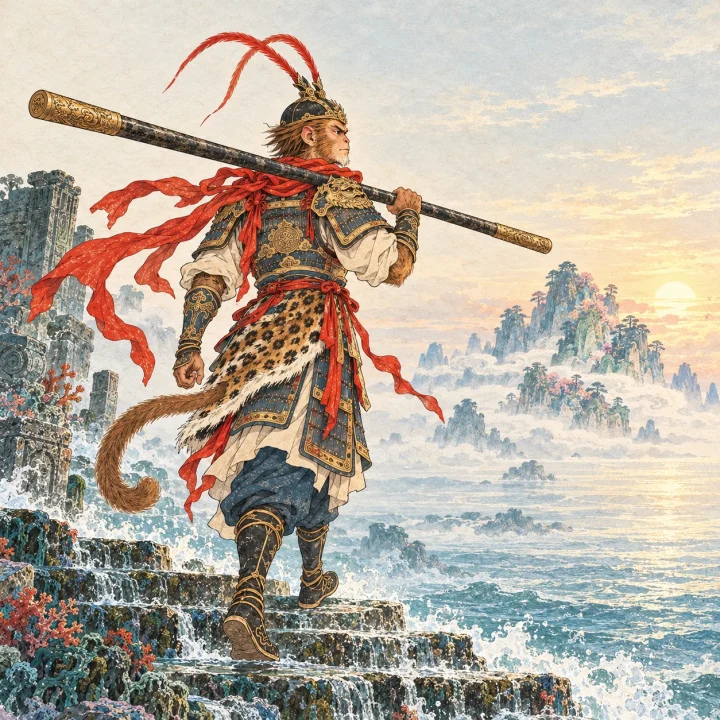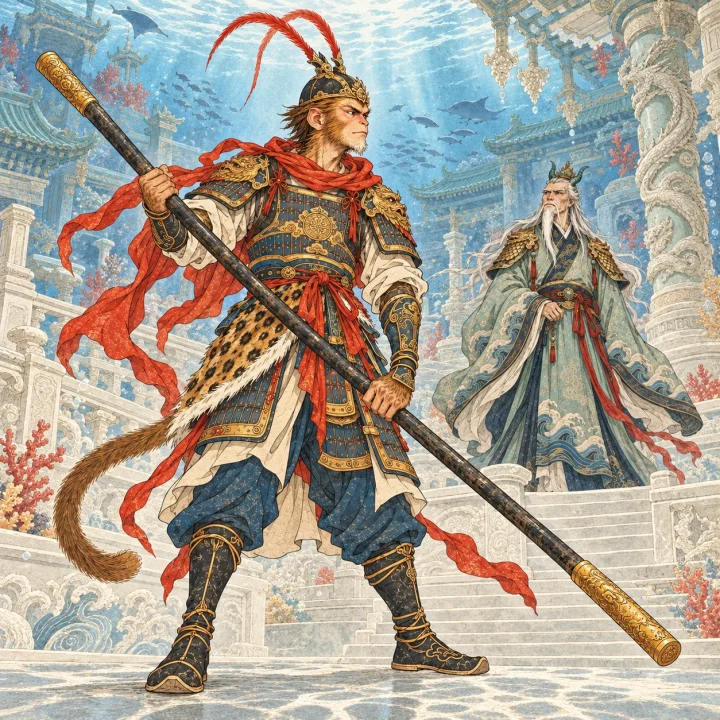
The armouries of the Eastern Sea stood open, and still Sun Wukong had not found a weapon he wanted. Blades, spears, forks, and halberds flashed beneath the pearl lamps of the Dragon Palace. He took each offering from the sea officers, tested its balance, and handed it back. The weapons that required several attendants to carry felt almost weightless in his hands. Each refusal left another treasure lying across the tiled floor and another courtier wondering what the visitor might demand next.
Sun Wukong had come because strength without a suitable weapon had begun to feel incomplete. After returning to the Mountain of Flowers and Fruit, he had armed and drilled the monkeys who followed him, yet he himself possessed nothing worthy of their king. Ao Guang, the Dragon King of the Eastern Sea, was a powerful neighbour with storehouses full of spirit weapons. Wukong therefore entered the sea, announced himself as a fellow immortal, and asked—very politely, in his own estimation—to be given one.
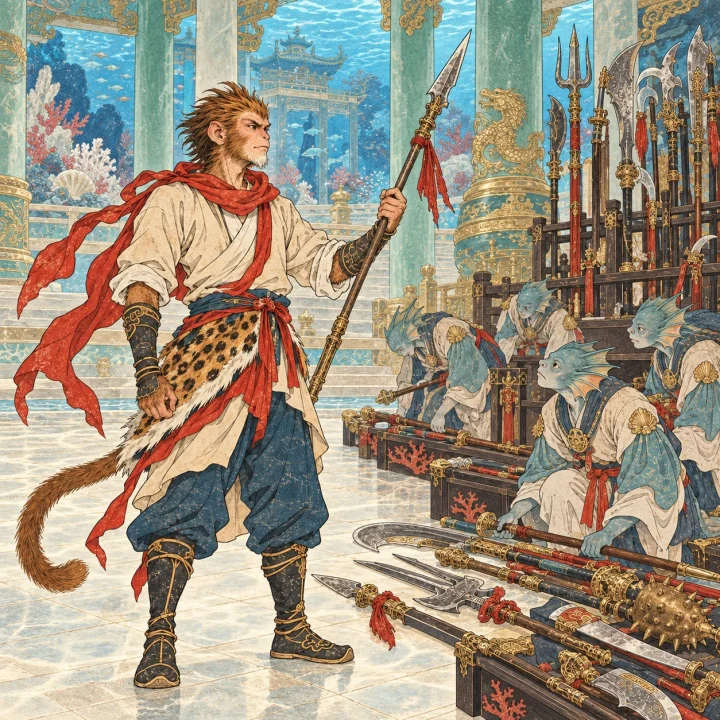
Ao Guang first offered a long-handled saber. Wukong said it was not his kind of weapon. A nine-pronged fork weighing 3,600 jin came next, followed by a great halberd weighing 7,200. Wukong performed a few movements with each and returned them with the same verdict: too light, not right. The Dragon King’s formal smile tightened. If the heaviest weapon in the palace could not satisfy this guest, courtesy was becoming difficult to distinguish from surrender.
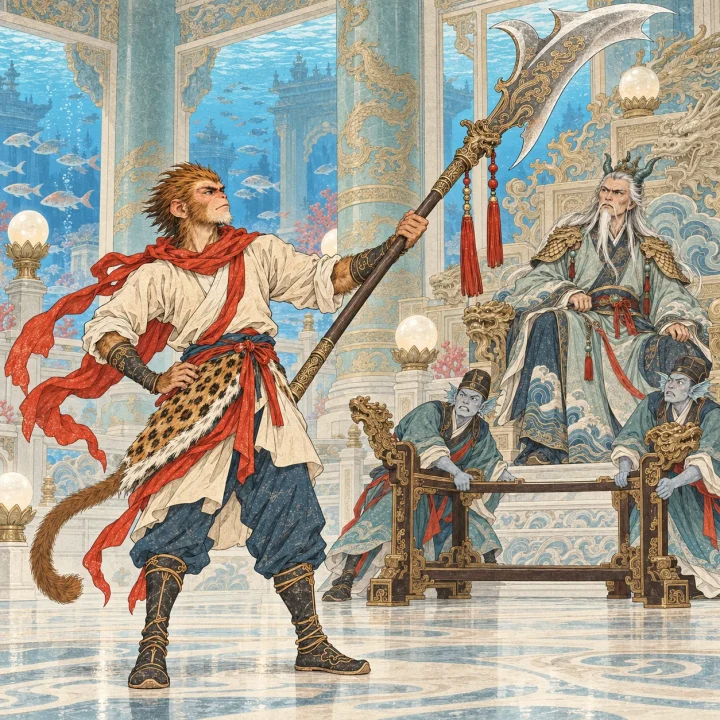
Then the Dragon Queen and the dragon princesses remembered something in the sea treasury. For several days, a piece of divine iron had been giving off brilliant rays and auspicious vapour. No soldier used it, and no craftsman had made it into a blade. It was older than the palace’s ordinary weapons and so heavy that the court had treated it as part of the seascape. Now its light seemed less like a warning than a summons.
The iron was associated with Yu the Great, the ancient flood-tamer. In the novel, it had served as a measure for determining the depths of rivers and seas while the waters were being brought under control. When that labour ended, the object remained in the treasury of the Eastern Sea: not a spear, not a sword, but a piece of world-ordering equipment waiting where no ordinary warrior could move it.
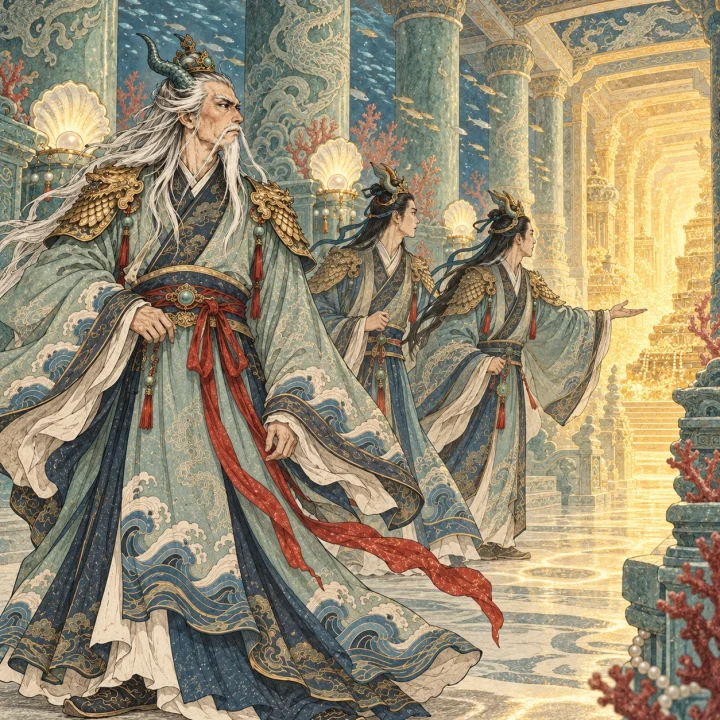
Ao Guang led Sun Wukong to the source of the light. There stood a single immense iron pillar, more than two zhang long and as thick as a large grain measure. Its middle was dark iron, while matching gold hoops enclosed its two ends. Close to one hoop ran an inscription: Ruyi Jingu Bang—13,500 jin. The name identified the object that English readers often call the Monkey King’s staff.
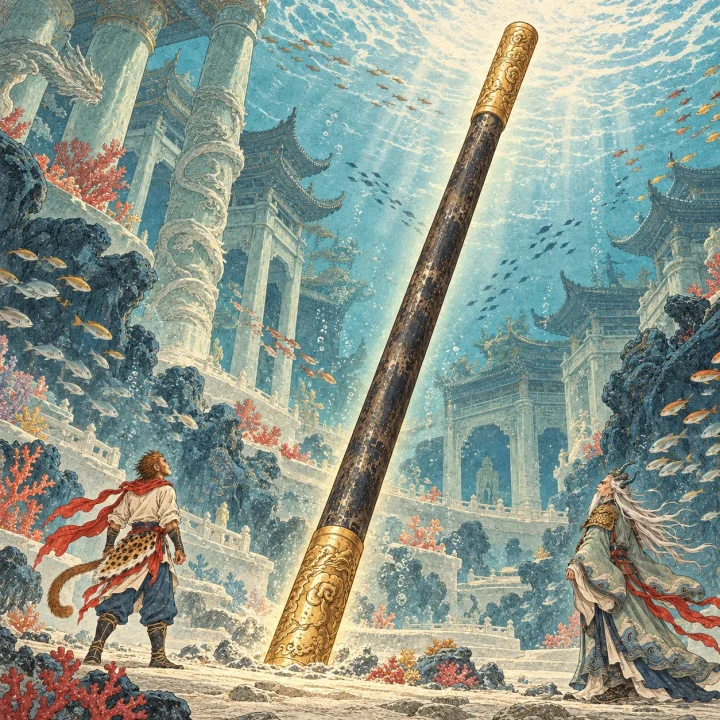
Sun Wukong walked around the pillar and considered its proportions. “It would be useful,” he said, “if it were only a little shorter and thinner.” The iron immediately contracted. He spoke again; it shortened again. The Dragon King and his court stared at an object they had stored for ages but had never truly commanded. The pillar was not merely being lifted. It was listening.
At last the iron reached a length and thickness that suited Sun Wukong’s hands. He raised the Ruyi Jingu Bang and tested its balance as though the two of them had practised together for years. The number carved into the shaft had not changed. What changed was the relationship between weapon and wielder: the impossible weight had finally met a strength—and a will—that could answer it.
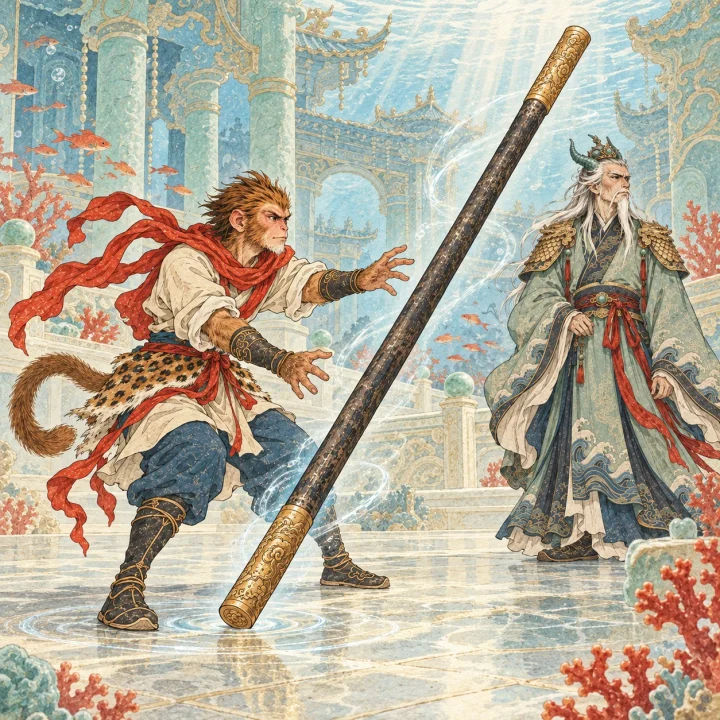
Delighted, Sun Wukong thrust, swept, and spun his new staff through the water. Currents rolled across the halls. Fish fled between coral branches, turtles drew into their shells, and the palace seemed to tremble around the Dragon King. This was no longer an ancient measuring iron standing harmlessly in storage. In the Monkey King’s hands, the single black-and-gold pillar had become a weapon alive with motion.
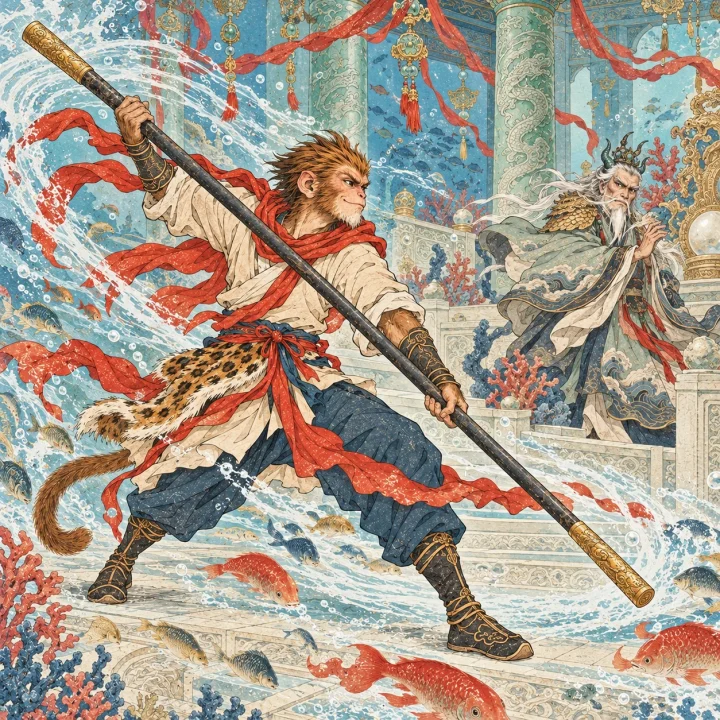
The central power of Sun Wukong’s staff is transformation of size. At its owner’s command, the Ruyi Jingu Bang can lengthen, shorten, thicken, or narrow without becoming a different object. A tower-sized pillar and a fighting staff are not separate copies; they are two states of the same miraculous iron. That distinction matters both to the story and to the way the weapon should be pictured.
When Sun Wukong does not need the staff at full size, he reduces it to something as small as an embroidery needle and keeps it in his ear. A weapon that weighs 13,500 jin can therefore travel almost invisibly with him, ready to expand the instant danger appears. The trick is practical, comic, and unmistakably his: an overwhelming force stored in a place so ordinary that an enemy might never notice it.
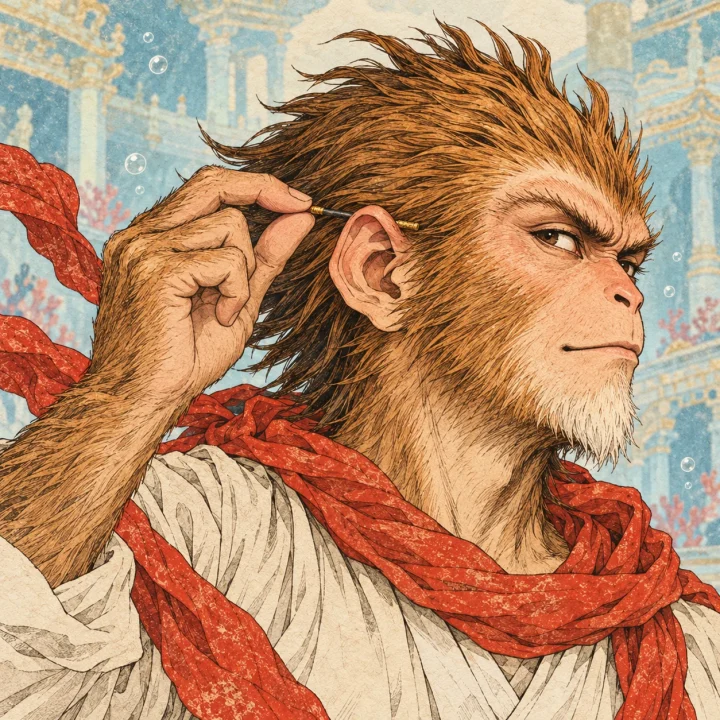
The novel does not pause to explain why the staff and the Monkey King suit each other so perfectly, but the pairing invites interpretation. Sun Wukong is a master of transformation who resists every fixed rank and boundary imposed upon him. His weapon follows the same grammar. Neither remains the size, shape, or place that others assign to it. Their affinity turns change itself into a form of power.
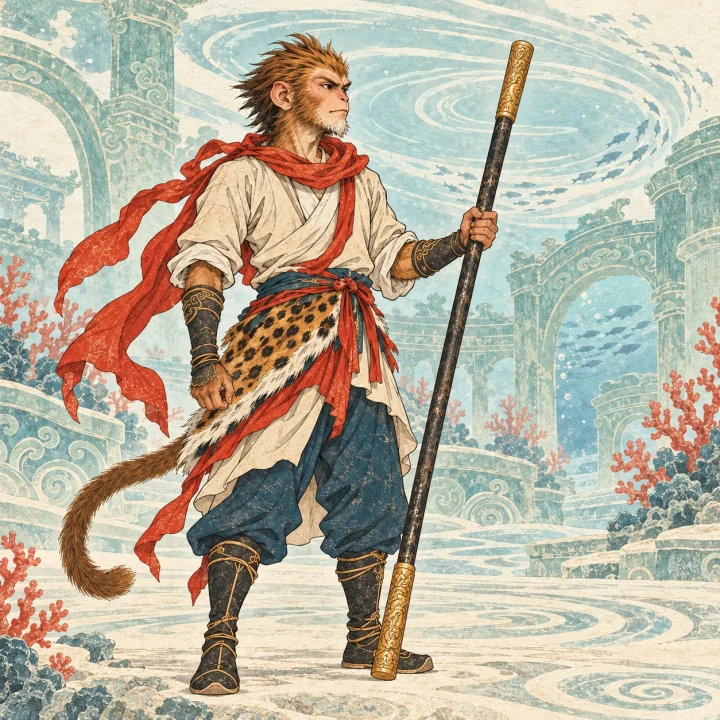
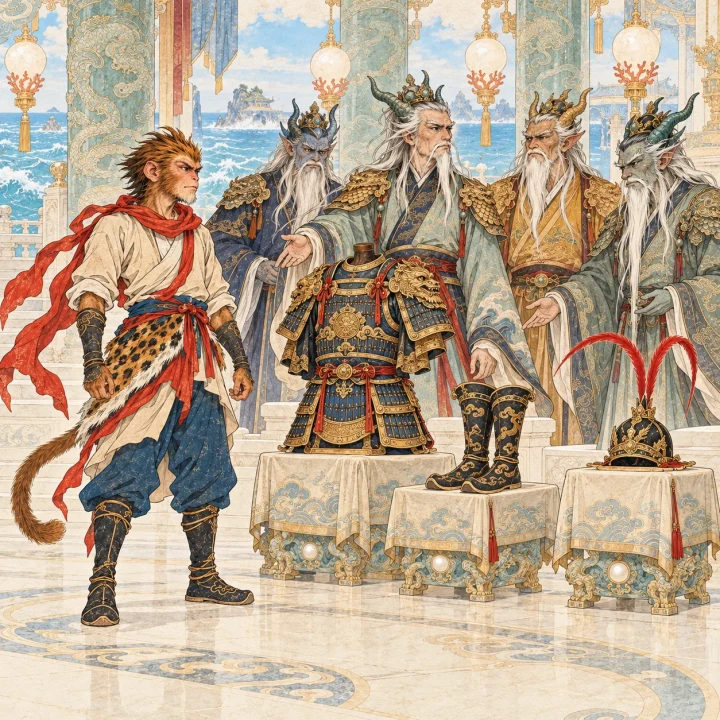
Possessing the perfect weapon did not make Sun Wukong ready to leave. He looked at his plain clothes and decided that a staff of such quality required armour to match. Ao Guang protested that the Eastern Sea had no suitable outfit to give him. Wukong, now holding the heaviest weapon in the treasury, was in an unusually persuasive position. The Dragon King called his brothers from the other three seas and asked them to solve the new problem together.
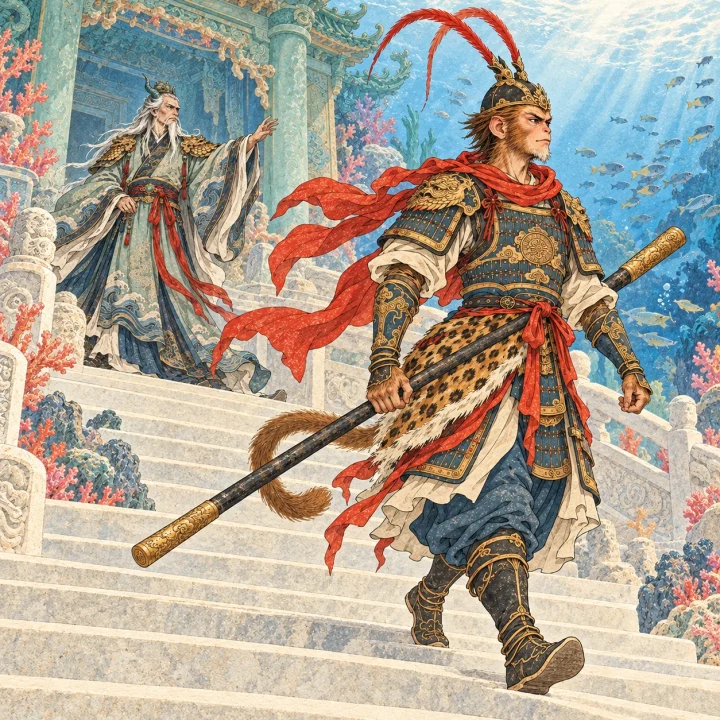
The four Dragon Kings arrived with three magnificent gifts: golden chain mail, cloud-walking shoes, and a phoenix-feather cap. Sun Wukong put them on over the same traveller’s clothes in which he had entered the palace. The change completed the figure later remembered as the Monkey King—a bright-crowned warrior in armour, carrying the dark iron staff with gold at both ends.
Sun Wukong departed in triumph, but the Dragon Kings did not regard the visit as a friendly exchange. Ao Guang later sent a memorial to Heaven accusing him of intimidation and theft. The staff’s discovery therefore did more than give the Monkey King his most famous weapon. It also helped set the heavenly authorities against him, carrying the story one step closer to his rebellion against the celestial court.
What is Sun Wukong’s staff called?
Sun Wukong’s staff is called the Ruyi Jingu Bang (如意金箍棒). Ruyi means “as one wishes” or “compliant with one’s will.” Jingu refers to the gold hoops or bands, and bang means a cudgel or staff. English translations therefore include “As-You-Will Gold-Banded Staff” and “Compliant Gold-Rimmed Cudgel.” The name describes both its appearance and its defining ability to obey its owner’s intention.
How much does Ruyi Jingu Bang weigh?
The inscription in Journey to the West gives the Ruyi Jingu Bang’s weight as 13,500 jin. Because the value of a jin changed across Chinese history, modern kilogram conversions vary and can imply more precision than the novel provides. The narrative comparison is clearer: Wukong dismissed weapons weighing 3,600 and 7,200 jin before choosing this one. To everyone else it was immovable infrastructure; to him it was finally the right weight.
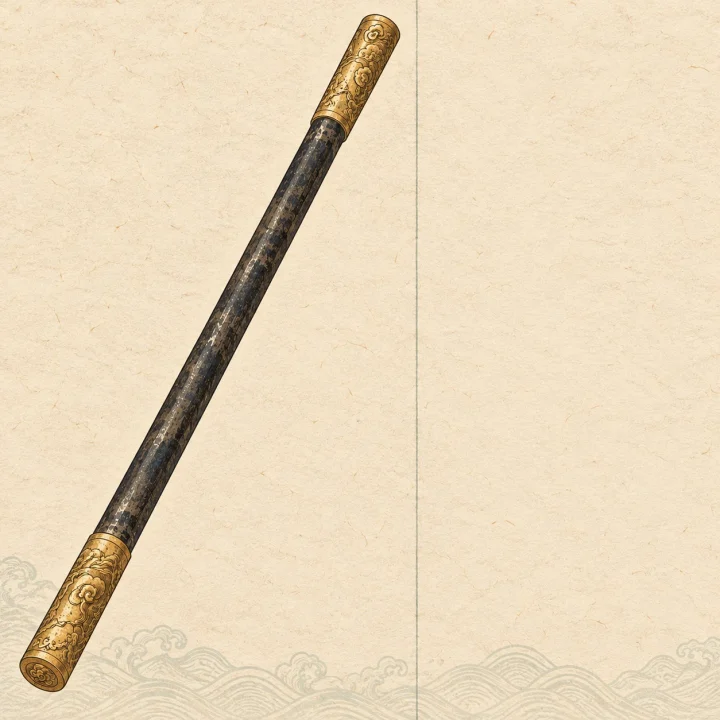
- As-You-Will Gold-Banded Staff
- Dark iron shaft · gold ends
- 13,500 jin in the novel
- Changes length and thickness
- Shrinks to embroidery-needle size
- Kept behind Sun Wukong’s ear
The Monkey King’s staff endures because its story is more than an origin for a famous weapon. A tool once used to measure and order the waters meets a hero who refuses to be measured by ordinary standards. It glows before he reaches it, changes when he speaks, and follows him from the sea into every later adventure. The Ruyi Jingu Bang does not simply make Sun Wukong stronger. It gives visible form to what he already is: restless, adaptable, excessive, and impossible to contain.