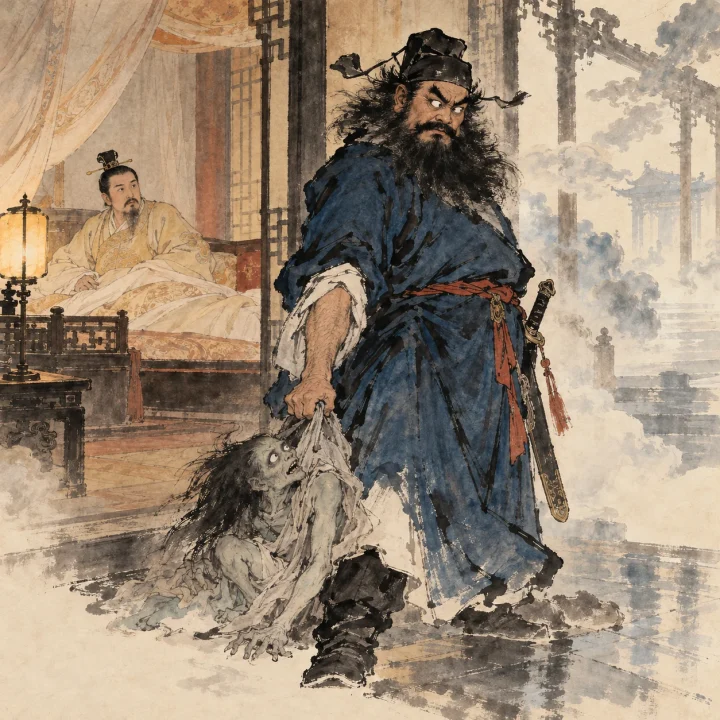
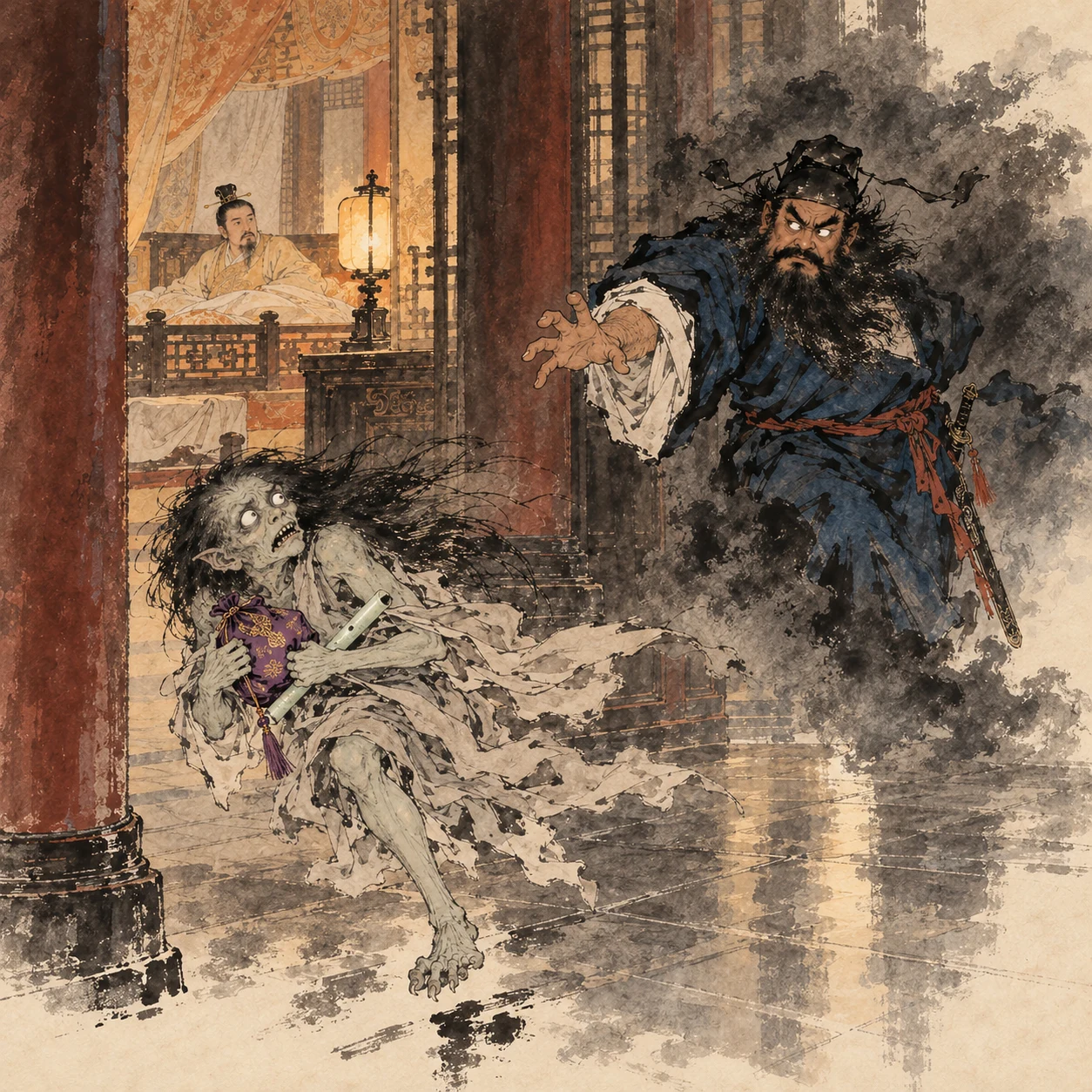
Emperor Xuanzong had been ill for many days when a strange dream came to him. A little ghost slipped into the palace, stole a purple perfume pouch and snatched away the emperor’s jade flute. It darted between the pillars, laughing at guards who could neither see nor catch it. Then the lamps bent in a sudden wind. A broad-shouldered figure strode out of the darkness, seized the thief and threw it to the floor. His beard curled like black wire; beneath heavy brows, his eyes burned so fiercely that even the ghost began to tremble.1「忽一大鬼頂破帽、衣藍袍、束角帶,徑捉小鬼,先刳其目,然後擘而啖之。」——《夢溪補筆談》所錄唐代題記。
“Who are you?” the emperor asked. The stranger bowed. “My name is Zhong Kui, a scholar from Zhongnan Mountain. While I lived, I travelled to the capital believing that learning could decide a man’s future. I discovered that a face may be judged before a single word is heard.” Then, while the feverish emperor listened, Zhong Kui began the story of how a scholar became the hunter of demons.
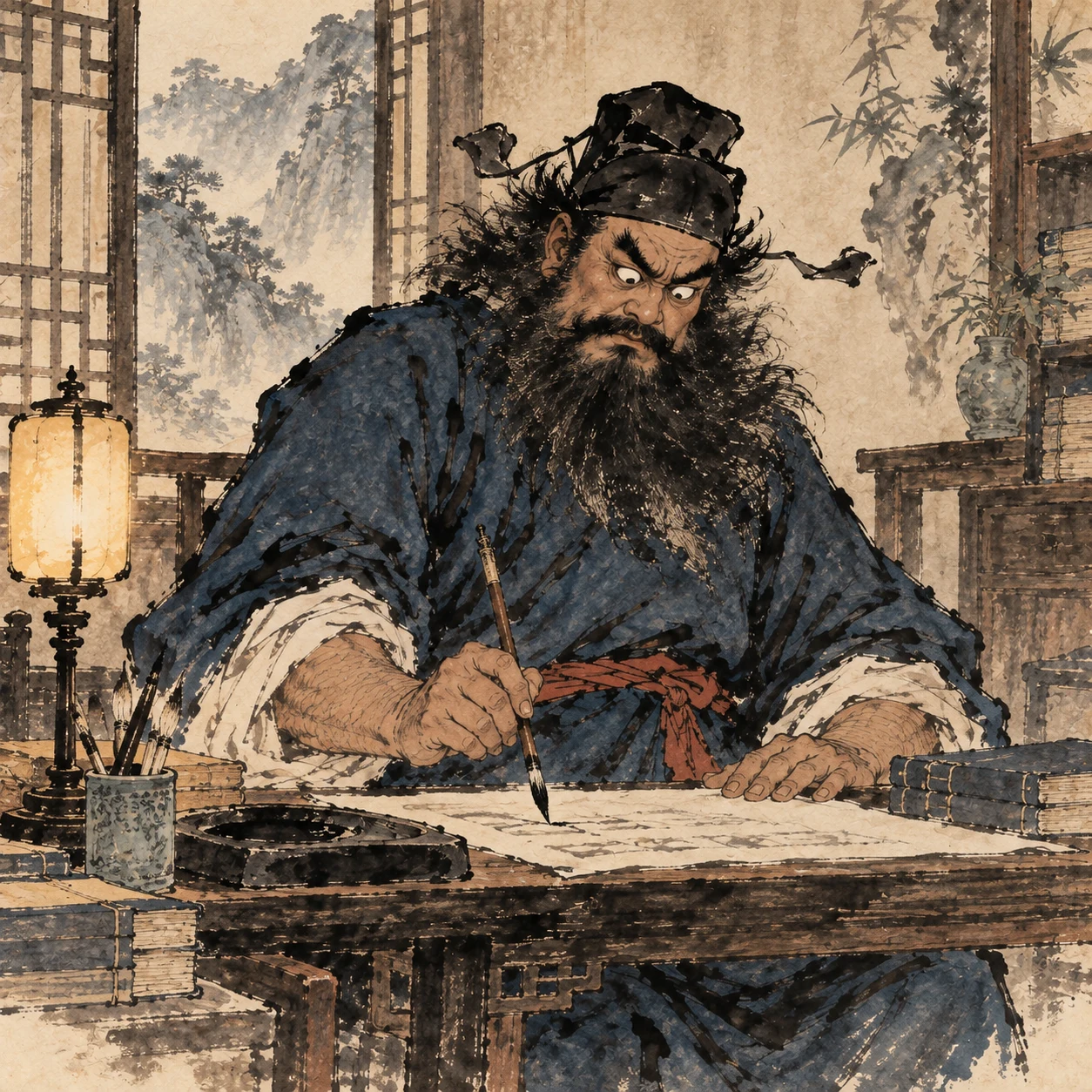
Long before the palace dream, Zhong Kui was known less for his frightening face than for the mind behind it. Later storytellers described him with round, glaring eyes, a dark iron-coloured face and a thick, twisting beard. Yet the same account immediately adds that every essay from his brush was splendid, every written line precious, and that he was upright by nature and unafraid of evil.2「生的豹頭環眼,鐵面虯鬚,甚是醜惡怕人。誰知他外貌雖是不足,內才卻甚有餘,筆到時,篇篇錦繡,墨到處,字字珠璣。且是一生正直,不懼邪祟。」——《斬鬼傳》第一回。 He did not study merely to remember old sentences. He studied until he could take a difficult question apart, find its centre and answer it in words that were entirely his own.
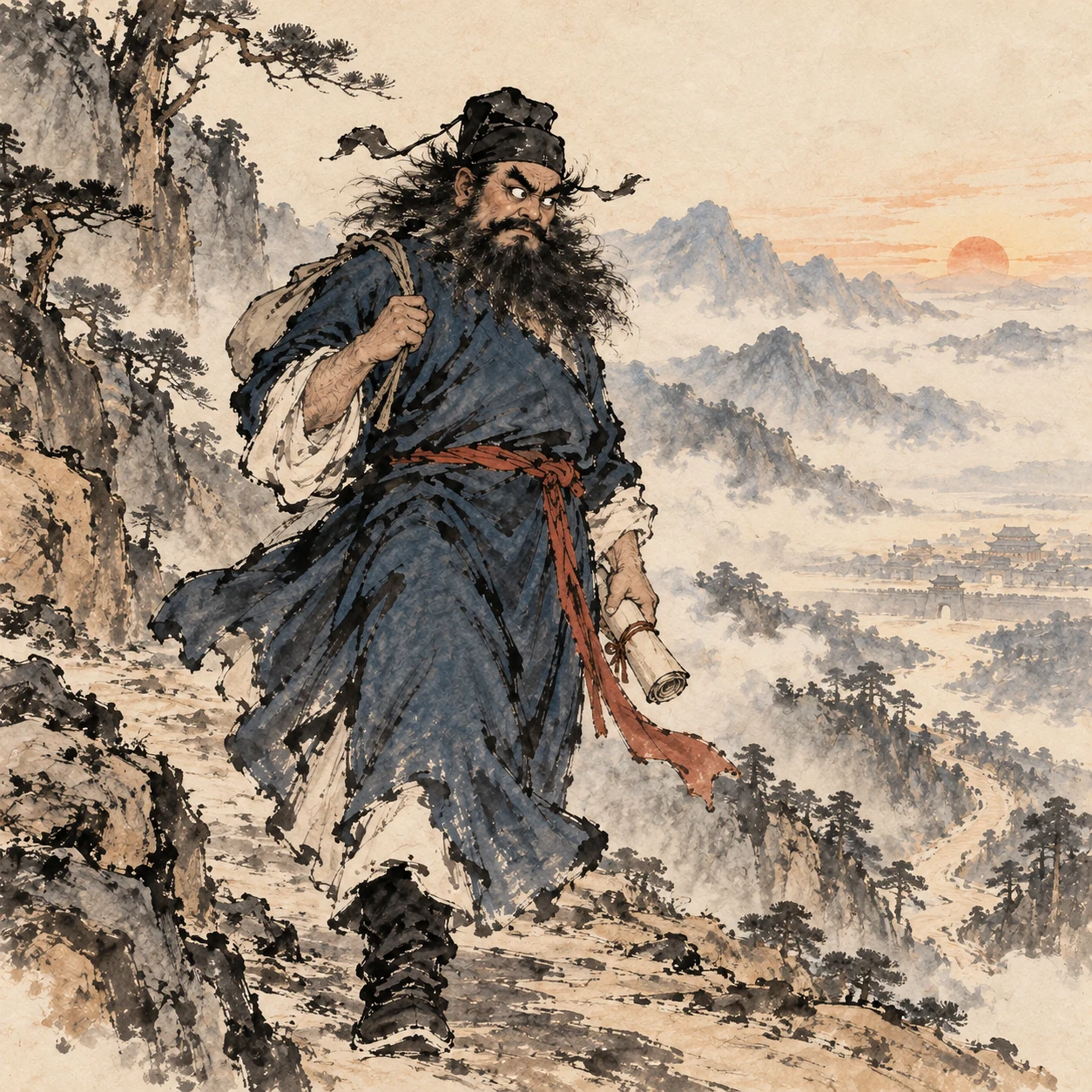
The examination became the measure of all those years. When the season arrived, Zhong Kui said farewell to his relatives and friends and set out for the capital. The road was long enough for hunger, thirst, cold inns and mornings that began before sunrise.3「這鐘馗別了親友,前去應試,一路上免不得飢餐渴飲,夜宿曉行。」——《斬鬼傳》第一回。 At every town, strangers stared. Some children hid behind their parents; some travellers whispered after he had passed. Zhong Kui kept walking. If the examination truly judged the mind, he told himself, then the capital was the one place where his face should not matter.
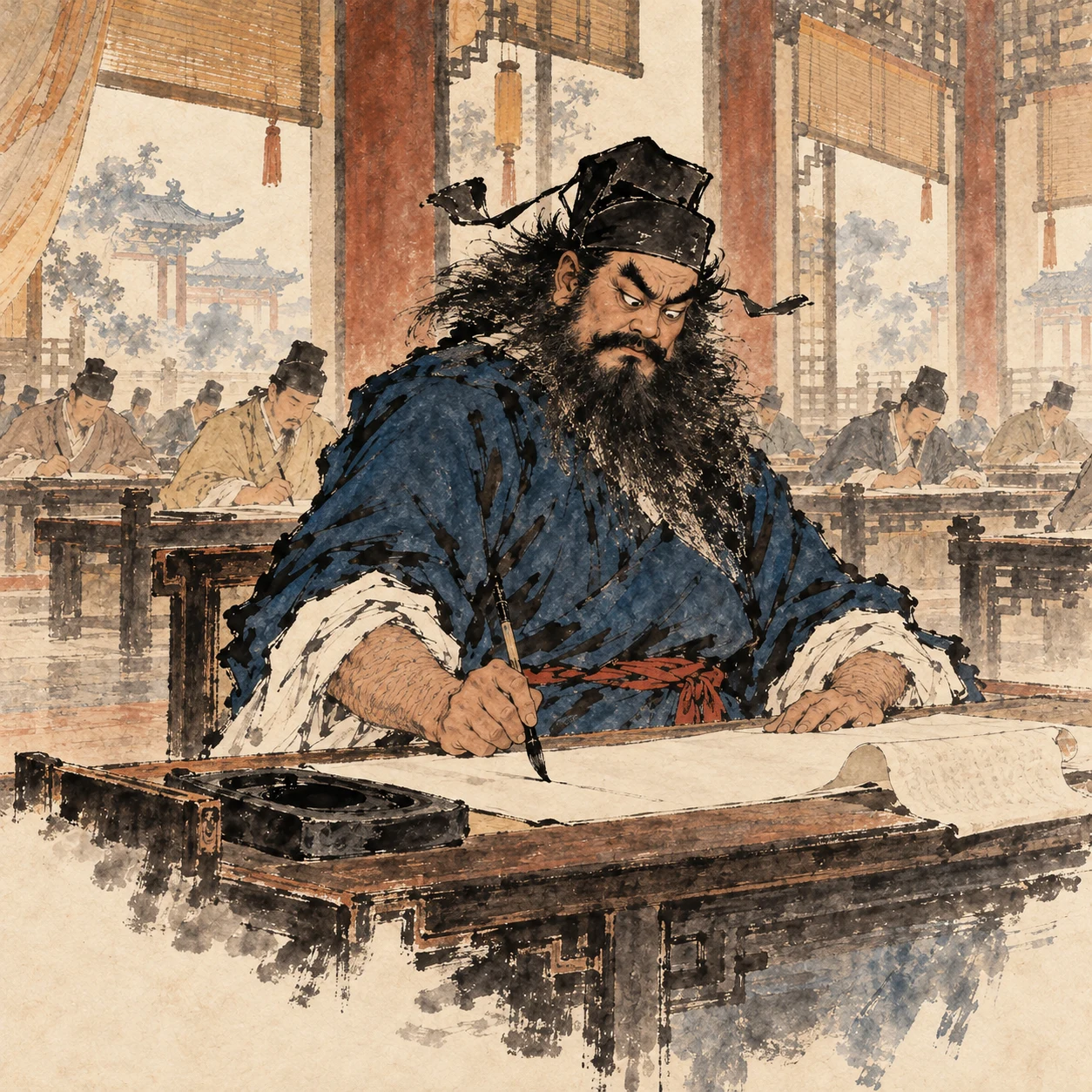
On the appointed day, he entered the hall and sat before ink, paper and an imperial question. Here there were no roadside glances, only the silence of candidates and the scratch of brushes. Zhong Kui read the prompt once. Years of preparation seemed to gather at the point of his brush. He began without hesitation and finished in one unbroken sweep. In later versions of the tale, the examiners looked at his paper and marvelled that a talent like his had not appeared since the great poets of old.4「鍾馗……提起筆來,不假思索,一揮而就。」考官讀後又讚:「奇才!奇才!」——後世《鍾馗傳》。 For the first time on his journey, Zhong Kui allowed himself to imagine returning home with honour.
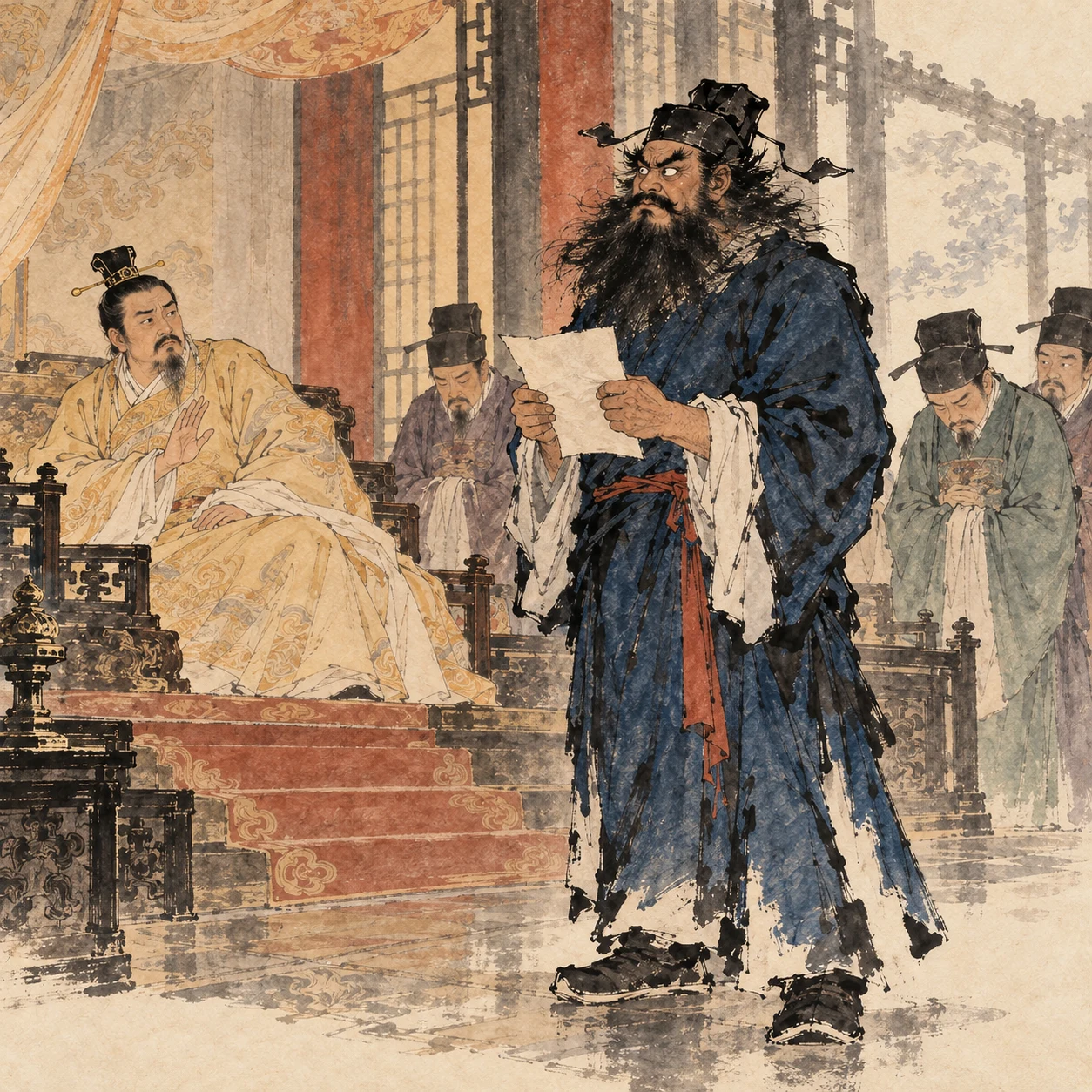
His paper was placed first. But when he was summoned before the court, the rules changed. The polished floor reflected embroidered robes; officials stood in faultless rows; no one spoke as Zhong Kui approached the throne. The ruler studied his severe features and recoiled. How, he demanded, could a man so ugly be presented as the finest scholar in the empire? The writing that had astonished the examiners was suddenly no longer enough.5「我朝取人全在文貌彬優,這人醜惡異常,如何做得狀元?」——《鍾馗傳》。
Zhong Kui looked from the throne to the officials who had praised his work. “Was the examination meant to judge a man’s learning,” he asked, “or the shape of his face? Has one word on my paper become less true since I entered this hall?” No one answered him plainly. A few men lowered their eyes. Others urged him to accept the decision with dignity, as though obedience could turn humiliation into justice.
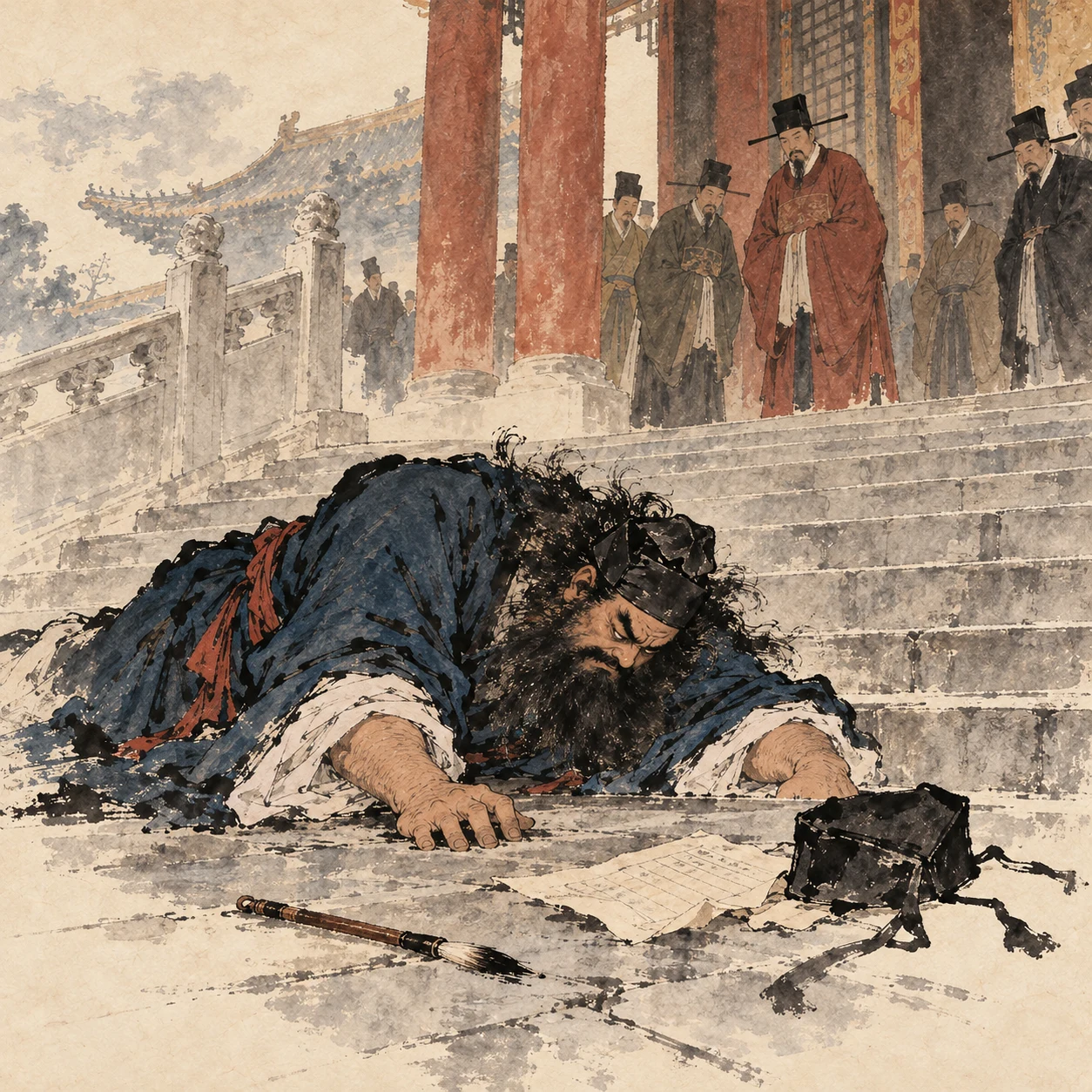
The blow cut so deeply because Zhong Kui had trusted the promise of the examination. He had not asked for favour. He had crossed the long road, answered the question and surpassed the other candidates by the court’s own measure. Now the same court used a measure it had never written down. In fury and despair, Zhong Kui struck his head against the palace steps and died before the officials who had refused to see him as worthy.6「臣終南山進士鍾馗也。因武德年中應舉不捷,羞歸故里,觸殿階而死。是時奉旨賜綠袍以葬之。」——《夢溪補筆談》所錄唐代題記。
Silence fell across the hall. Too late, the ruler understood what his judgment had caused. He ordered Zhong Kui to be buried in an official’s robe, with the honours that had been withheld from him in life. The funeral could restore his title, but not his breath. Zhong Kui entered the realm of spirits carrying two things the court could no longer take from him: the dignity he had earned and the memory of an injustice he would never repeat.
The ghosts expected another wounded soul. Instead, Zhong Kui stood upright. Death had not softened his terrible face; it had made it commanding. He knew better than anyone that ugliness was not wickedness, and that evil should be judged by what it did. The spirits that crept through unguarded doors, fed on sickness and tormented sleepers could no longer hide behind appearances. Zhong Kui drew his sword and vowed to rid the realm of harmful demons.7「感恩發誓,與我王除天下虛耗妖孽之事。」——《夢溪補筆談》所錄唐代題記。
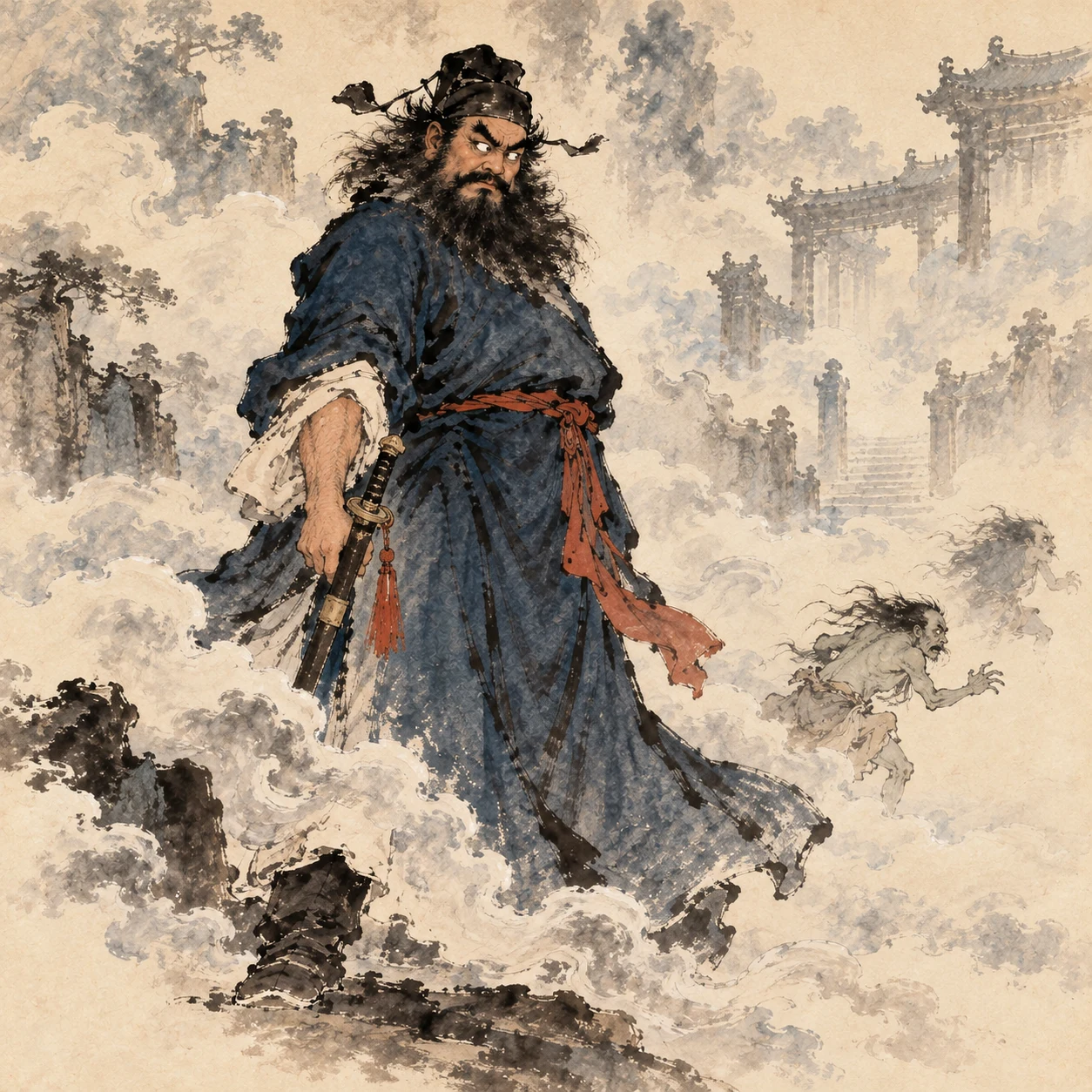
That vow carried him into Emperor Xuanzong’s dream. The little thief kicked and twisted in his grasp, but Zhong Kui did not release it. “I could not serve the court while I lived,” he told the emperor, “so after death I will clear the empire of demons.” He recovered the stolen treasures and vanished as morning light entered the palace.
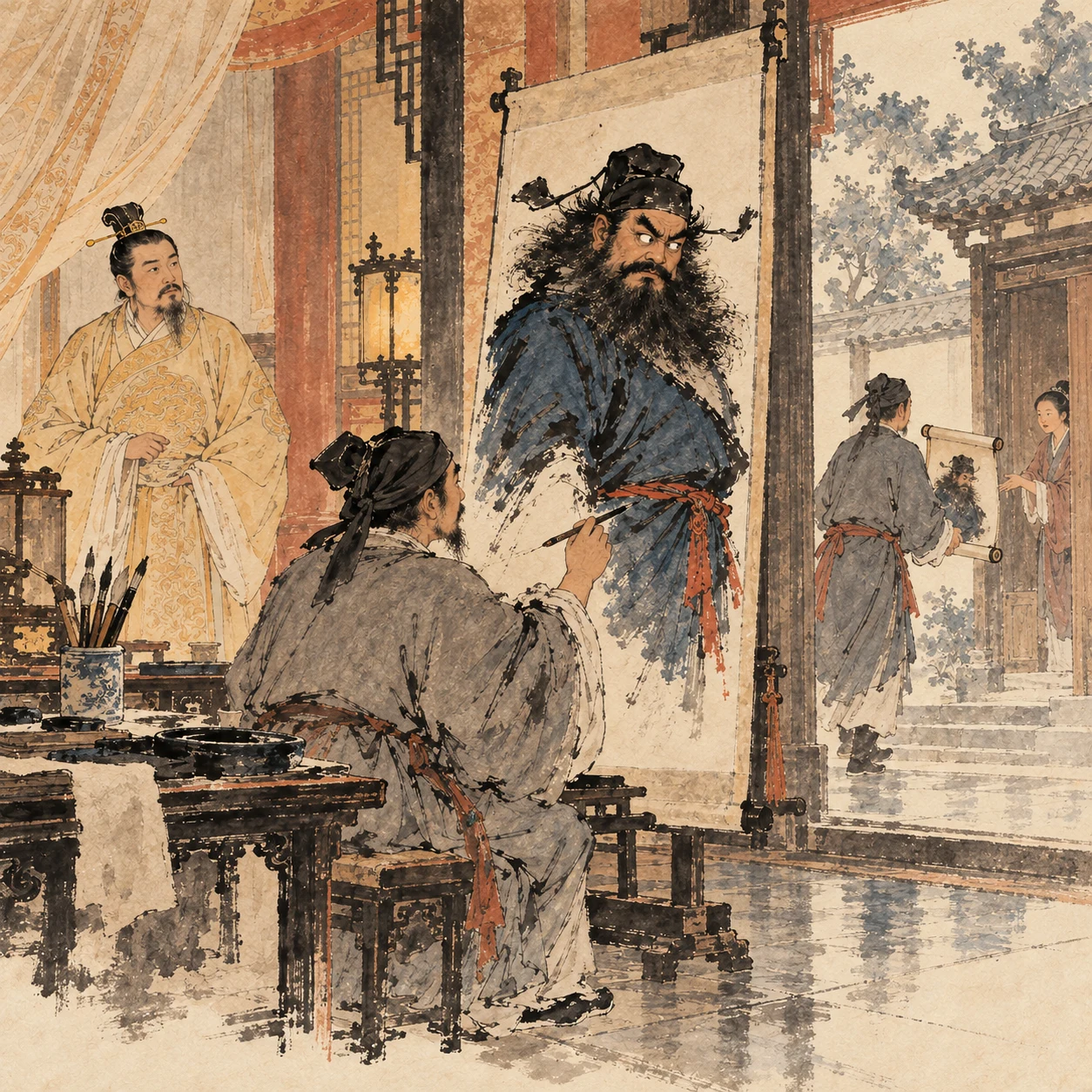
Xuanzong awoke, and the illness that had held him was gone. He ordered an artist to paint the guardian exactly as he had appeared in the dream. From the palace, Zhong Kui’s fierce likeness travelled into ordinary homes and above doorways. The scholar once rejected because people feared his face became the protector people welcomed for precisely the same reason: no demon could bear to meet his gaze.
Story notes
Hover over or focus a note to read the original Chinese passage.
1. Emperor Xuanzong’s dream
The earliest surviving written layer is not a full biography but Xuanzong’s dream: a small ghost steals from the palace, and Zhong Kui appears to subdue it.
「忽一大鬼頂破帽、衣藍袍、束角帶,徑捉小鬼,先刳其目,然後擘而啖之。」——《夢溪補筆談》所錄唐代題記。
2. Appearance, talent and character
A later novel supplies the vivid contrast at the centre of the retelling: Zhong Kui’s frightening appearance, exceptional writing and upright, fearless nature.
「生的豹頭環眼,鐵面虯鬚,甚是醜惡怕人。誰知他外貌雖是不足,內才卻甚有餘,筆到時,篇篇錦繡,墨到處,字字珠璣。且是一生正直,不懼邪祟。」——《斬鬼傳》第一回。
3. The journey to the examination
The source says that Zhong Kui took leave of relatives and friends and endured the ordinary hardships of a long journey. It does not identify his parents or grandparents.
「這鐘馗別了親友,前去應試,一路上免不得飢餐渴飲,夜宿曉行。」——《斬鬼傳》第一回。
4. Written in one sweep
The confident examination scene comes from the expanded literary biography rather than the earlier dream account.
「鍾馗……提起筆來,不假思索,一揮而就。」考官讀後又讚:「奇才!奇才!」——後世《鍾馗傳》。
5. First place lost because of his face
Later fiction makes the injustice explicit: Zhong Kui’s writing earns first place, but the court rejects him when it sees his face. Details vary between versions.
「我朝取人全在文貌彬優,這人醜惡異常,如何做得狀元?」——《鍾馗傳》。
6. Death and official burial
The older account says he failed in the examination and struck the palace steps, then received a green official robe for burial.
「臣終南山進士鍾馗也。因武德年中應舉不捷,羞歸故里,觸殿階而死。是時奉旨賜綠袍以葬之。」——《夢溪補筆談》所錄唐代題記。
7. The vow to drive out demons
Zhong Kui’s promise to rid the realm of harmful spirits belongs to the early dream tradition.
「感恩發誓,與我王除天下虛耗妖孽之事。」——《夢溪補筆談》所錄唐代題記。
Version boundary
There is no single early text containing Zhong Kui’s complete life. This retelling joins the Xuanzong dream preserved in Shen Kuo’s Supplement to Dream Pool Essays with the richer scholar biography developed in later novels. Conversations, private thoughts and the texture of his years of study are narrative reconstruction.
現存早期文獻沒有一篇完整連續的鍾馗傳記;本文把《夢溪補筆談》保存的玄宗夢鍾馗,與後世小說發展出的書生生平接在一起。


