The twelve trials are finally over.
Hercules stood outside the city gate of Mycenae, looked at the sky in the distance, and took a deep breath. The ten-year road to atonement has come to an end. He killed the lion of Nemea, beheaded the Hydra, recovered the golden-horned doe, captured the wild boar of Erymanthus alive, cleaned the cattle pen of Ogias, drove away the strange birds of Stymphalis, subdued the bull of Crete, brought back the human horse of Diomedes, captured Hippolyta’s belt, drove away Geryon’s cattle, picked up the golden apples from the end of the world, and even brought back three hellhounds from the underworld alive.
Now, he is finally free.
But after freedom, where to go? What to do? Heracles didn’t know. All he knew was that he couldn’t stop. A hero’s mission will not end when the trial ends.
So he hit the road again, heading towards the unknown distance.
A few months later, Hercules arrived at the city of Troy on the east coast of the Aegean Sea.
The city is located at the entrance to the Dardanelles. The city walls are towering and made of huge stones. They are so strong that they seem to be able to withstand all attacks in the world. It is said that this wall was built by the hands of Poseidon, the god of the sea, and Apollo, the god of the sun, so no one can break it.
However, when Heracles reached the coast outside the city, what he saw was not prosperity and peace, but fear and despair.
Countless Trojans gathered on the beach, men, women, old and young, all dressed in black mourning clothes, with sadness and helplessness written on their faces. They gathered in a circle, knelt on the ground, wept and prayed toward the sea. Hercules came closer and saw clearly the object of their prayers.

On a huge rock on the coast, a young woman was tied with iron chains, her hands raised above her head, and her ankles were locked tightly, unable to move. She was wearing a gorgeous robe and a golden headdress. She was obviously of noble birth, but there was no arrogance on her face at this moment, only deep fear and despair. Tears slipped from her cheeks, dripped on the rocks, and were swept away by the waves.
Hercules stopped an old man and asked, “What’s going on? Why is that girl tied there?”
The old man raised his head, his eyes full of tears, “That is our princess, Hesione, the daughter of King Laomedon. She…she is going to be dedicated to the sea monster.”
“Sea monster?”
The old man nodded, his voice trembling, “Poseidon’s punishment. The monster will appear from the sea every few days, devour our ships, destroy our ports, and kill our fishermen. The oracle said that only by sacrificing the king’s daughter will the sea monster leave and Troy be saved.”
Hercules frowned, “Why did Poseidon punish Troy?”
The old man sighed, “Because of King Laomedon’s treachery.”
The story starts many years ago.
At that time, Troy was just a small city-state. King Laomedon was ambitious and wanted to build an invincible city. He prayed to the gods and promised that if any god was willing to help him build the city wall, he would offer the most generous reward.
Poseidon, the god of the sea, and Apollo, the god of the sun, heard his prayer, transformed into mortal craftsmen, and came to Troy. The two gods used their divine power to lay stones, working day and night, and finally built an indestructible city wall.
However, when the project was completed and Poseidon and Apollo showed up and demanded payment from Laomedon, the king turned his back and refused to acknowledge the payment. Not only did he refuse to pay any reward, he even threatened to expel the two gods from the country.
The gods were furious.
Apollo sent a plague, causing disease to spread in Troy and countless people died. Poseidon summoned a huge sea monster from the deep sea, and let it wreak havoc on the coast of Troy, devouring all creatures that came close to the ocean.
Laomedon panicked and quickly turned to the oracle for help. The oracle’s answer was cold and cruel: “Only by sacrificing the king’s daughter to the sea monster will the disaster end.”
So Hesione was tied to the rock.
Hercules listened to the story, remained silent for a moment, and then strode toward the shore.
The crowd made a way, and everyone looked at the stranger wearing a lion skin and carrying a huge bow with awe and curiosity. Hercules walked to the rock and looked up at the tied princess.
Hesione also lowered her head and looked at him with teary eyes, “Who are you?”
“I am Heracles,” he said quietly, “I can save you.”
A glimmer of hope flashed in Hesione’s eyes, but it quickly dimmed. “No one can kill that sea monster. Its body is bigger than a warship, its skin is as hard as iron, and its sharp teeth can bite the thickest cable…”
“I have seen scarier monsters,” Hercules said flatly, “I need to see your father, King Laomedon.”

Soon, Hercules was taken into the palace of Troy.
Laomedon sat on a golden throne, wearing purple robes and a crown studded with precious stones. He looked majestic and noble, but Heracles saw the man’s true nature in his cunning eyes.
“I heard that you want to save my daughter?” Laomedon said, with a hint of arrogance in his tone.
“Yes,” said Hercules, “but I need payment.”
Laomedon raised his eyebrows, “What reward?”
“You have a group of divine horses,” said Hercules. “They were a gift from Zeus to your grandfather Telos to compensate for his son Ganymedes who was taken away by Zeus. Those horses are as fast as the wind and never tire. If I kill the sea monster and save your daughter, you will give me those divine horses.”
Laomedon pondered for a moment, then nodded slowly, “If you can really do it, I promise you.”
Heracles looked into his eyes, feeling vaguely uneasy, but he didn’t say anything more, just turned and left the palace.
At dusk the waves began to roll.
A strange thick fog rose from the sea, and a low roar came from the distance, like thunder from the abyss, making the entire coast tremble. The crowd screamed and backed away, but Heracles stood motionless.
Then, it appeared.
It was a monster larger than any creature anyone had ever seen. Its body floated up from the sea, setting off huge waves several feet high. The seawater flowed down from the gaps between its scales, making a hissing sound. Its head was like a hill, covered with sharp bone spurs, and its two blood-red eyes were like burning torches, staring at Hesione on the rocks.
The sea monster opened its mouth, revealing rows of teeth as sharp as swords, let out a deafening roar, and then rushed towards the reef.

Hercules moved.
He drew his big bow, and the arrow shot out like a meteor, hitting the sea monster’s eye. The sea monster roared in pain and jerked its head, but Hercules had already rushed forward, grabbed the scales on the sea monster’s neck with his bare hands, turned over and rode on its back.
The sea monster rolled wildly, trying to throw the tiny human off, but Hercules’ hands were like iron pliers, holding on tightly. He pulled out the dagger from his waist and stabbed the sea monster’s neck again and again. Blood gushed out like spring water, dyeing the entire sea water red.
The battle lasted for a long time. The sea monster struggled, roared, rolled, hit the rocks, and set off huge waves, but Hercules never let go. Finally, with the last shrill wail, the huge body of the sea monster slowly sank into the sea and never rose again.
The shore erupted in loud cheers.
Heracles walked back to the shore and unchained Hesione. The princess’s legs were weak and she could hardly stand. Hercules supported her and said, “You are safe.”
Hesione looked at him, her eyes full of gratitude, “Thank you… thank you…”
However, when Hercules returned to the palace and asked Laomedon for the promised horse, the king’s expression changed.
“The horse?” Laomedon sneered, “That is a treasure passed down from generation to generation in my family. How could I give it to an outside adventurer?”
Hercules’ face darkened, “You promised me.”
“I just said that if you can do it, I will consider it,” Laomedon waved his hand nonchalantly, “But now that I think about it, I feel that it is not appropriate. You have saved my daughter and gained honor and fame. Isn’t that enough?”

“You are breaking your promise,” Hercules said word by word.
“Whatever you think,” Laomedon stood up and looked at him condescendingly, “Now, leave my palace.”
Hercules didn’t move, his fists clenched tightly, veins bulging. The air in the entire hall seemed to freeze. The guards nervously held their weapons, but no one dared to step forward.
Finally, Hercules took a deep breath, turned and left.
But the moment he stepped out of the door, he turned back and said in a cold and firm voice: “I will come back, Laomedon. I swear, I will definitely come back.”
Hercules left Troy, but he did not forget Laomedon’s betrayal.
He spent several years traveling around, making friends with heroes, and accumulating strength. He found his old friend Telamon, the brave and fearless warrior who had adventured with him. He found Oicles, a wise and brave archer. He found other warriors willing to follow him, and assembled a total of six warships, each filled with elite warriors.
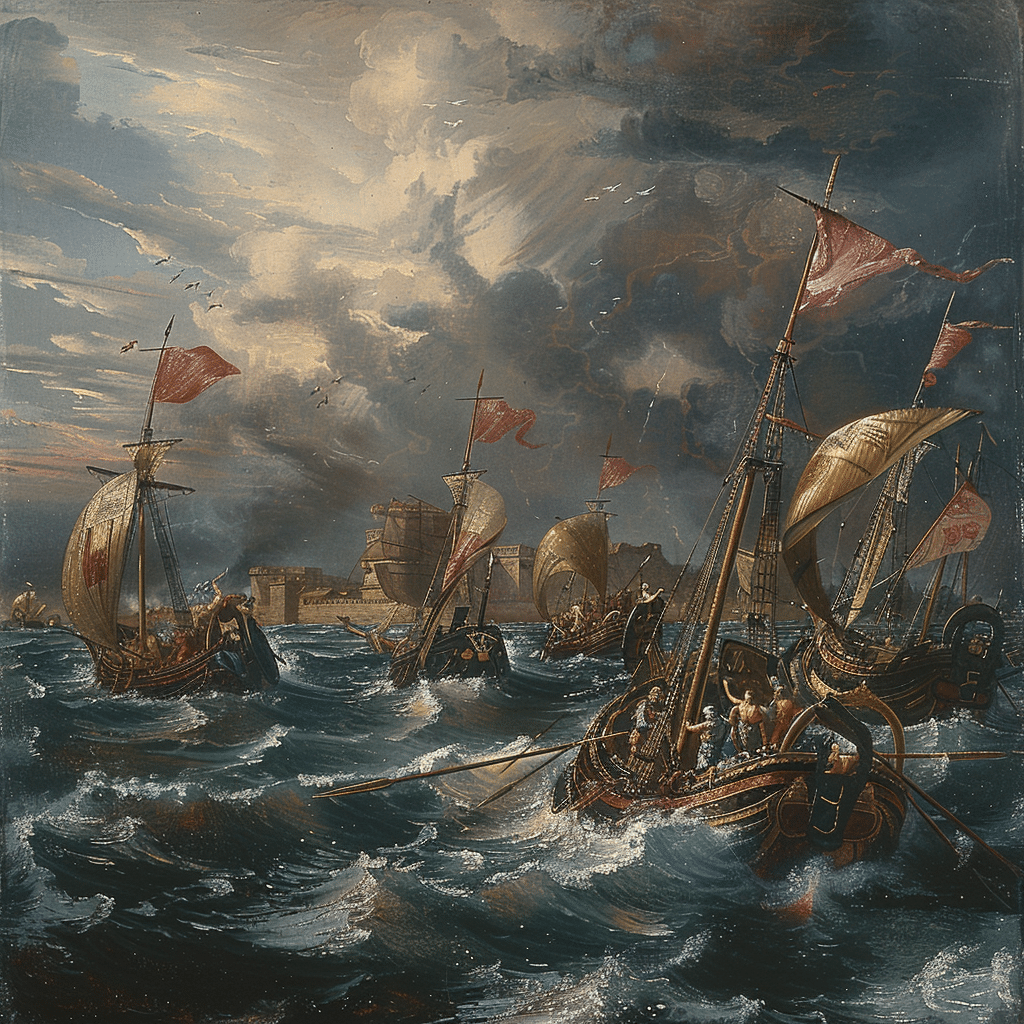
When everything was ready, Heracles led the fleet and sailed to Troy again.
On the watchtower of Troy, the guards saw the shadow of the ship appearing on the horizon in the distance.
At first they thought they were just ordinary merchant ships, but when the ships got closer and closer, with the battle flags raised on the bows fluttering in the wind, the guards’ expressions changed. They sounded the alarm, and the shrill bells echoed throughout the city.
Laomedon stood on the city wall, looking at the fleet, his face ashen.
“It’s Heracles,” the minister beside him said tremblingly, “He’s really back.”
“Only six ships,” Laomedon sneered, “Does he think he can break through Troy with just these people? This wall was built by Poseidon himself, and no mortal can break it!”
However, there was already a trace of unconcealed fear in his voice.
Hercules’ fleet lands on the beach.
Laomedon did not wait for Hercules to attack the city, but led his army to attack proactively, hoping to annihilate the enemy on the beach before they had a firm foothold. The Trojan army poured out of the city gates like a tide, with banners fluttering and shouts shaking the sky.
The two armies fought fiercely on the beach.

Heracles descended like a god of war, and with every arrow fired from his huge bow, a Trojan soldier fell. His club swung across the army, and all the enemies in front of him were knocked away. Telamon fought at his side, shield against the arrows and spears piercing the enemy ranks. Oicles’ arrows never missed, and every arrow hit the enemy’s vital point accurately.
The fighting lasted all day.
Although the Trojan army was large in number, it was defeated steadily by Hercules and his comrades. At dusk, Oicles was struck by an arrow and fell, becoming the first hero to die in the battle. Hercules knelt beside him, watching his old friend take his last breath, the rage in his heart burning even more fiercely.
Seeing that the situation was over, Laomedon hurriedly ordered a retreat, fled back to the city with the remaining defeated soldiers, and closed the city gate tightly.
Hercules stood under the walls of Troy, looking up at the huge stone walls that could be heard in the clouds.
This is an impregnable fortification built by Poseidon himself. But Hercules knew a secret – not all the walls were built by Poseidon.
When Poseidon and Apollo built the city, they invited the mortal hero Aeacus to assist. Although the section of the city wall that Aeacus was responsible for building seemed equally strong, it was not made by divine power after all and must have weaknesses.
And Aeacus is Telamon’s father.

“Tell me,” Hercules turned to Telamon, “where is the wall your father built?”
Telamon was silent for a moment, then pointed to the northwest corner of the city wall, “There. But even the part built by my father cannot be easily broken.”
“Then try it,” said Hercules.
As night fell, Hercules and Telamon quietly approached the northwest corner of the city wall.
Telamon carefully inspected every stone, and finally found the mark left by his father in an inconspicuous location – a stone with extremely minute symbols carved on it. He pushed hard and the stone loosened slightly.
The two looked at each other and began to work together to move the stone.
Soon, the first stone was removed, revealing the gap behind it. Then came the second, third… cracks began to appear in the wall. Telamon was the first to slip through the gap, followed closely by Hercules.
When they appeared in the city, Troy’s defenders were alarmed that something was wrong, but it was too late. Heracles opened the city gate, and the waiting warriors outside poured in like a tide.
Troy fell.
Laomedon led the princes to make a final resistance, but in front of Heracles, the perfidious king finally paid the price.
Hercules’ club fell, and Laomedon fell in a pool of blood. The princes fell one after another, and only the youngest, Podarces, escaped death because he was not in the palace at the time.
After the battle, Hesione was brought before Hercules.
The princess knelt on the ground with tears streaming down her face, “My father…my brothers…”
“Your father deserved his treachery,” Hercules said coldly, “but you are innocent.” He turned to Telamon. “She is yours as a reward for breaching the wall.”
Telamon helped Hesione up and said gently, “I will treat you well.”
Hesione wiped away her tears and said with a choked voice, “I…I have a request. My youngest brother Podarces is still alive. He is just a child and has never done anything bad. Please…please let him go.”

Hercules was silent for a moment and nodded, “Yes. But he must pay the price to redeem his freedom.”
Hesione took off the golden veil from her head and handed it to Heracles with both hands, “This is the only thing I have, please accept it.”
Hercules took the veil, “From now on, he will no longer be called Podarces. His name is Priam, which means ‘the redeemed one’. Let him remember that it was his sister’s sacrifice that bought his life.”
When Hercules left Troy, he gave the rule of the city to young Priam.
Hesione followed Telamon back to the island of Salamis, and later gave birth to a son named Teucer. Years later, the child grew up and became one of the best archers in Greece. What’s even more ironic is that he will return to his mother’s hometown as a member of the Greek coalition in another Trojan War and participate in the second and most famous destruction of Troy.
As for Heracles, he did not take any treasure, nor did he ask for the horses – those horses had long since been lost in the flames of war. He just boarded the ship silently and left the devastated city.
Revenge is complete and justice is served.
But there was no joy in Hercules’ heart, only a deep exhaustion. He looked at the horizon in the distance, thinking of the body of Oicles, the soldiers who fell on the battlefield, and the desperate tears of Hesione.
Some debts must be repaid with blood.
But after the blood debt was paid in blood, what was left was only more sadness and hatred.
Many years later, when Paris kidnapped Helen of Sparta and Priam refused to return it, the Greeks used this as an excuse to attack Troy again with a thousand warships. Some people say that the cause of all this is actually because Hesione was taken away by Telamon, and the resentment in the hearts of the Trojans has never dissipated.
Hatred, like a seed, will take root and sprout in the soil of time, and eventually grow into a towering tree, covering the entire sky.
And Hercules sowed the first seed.