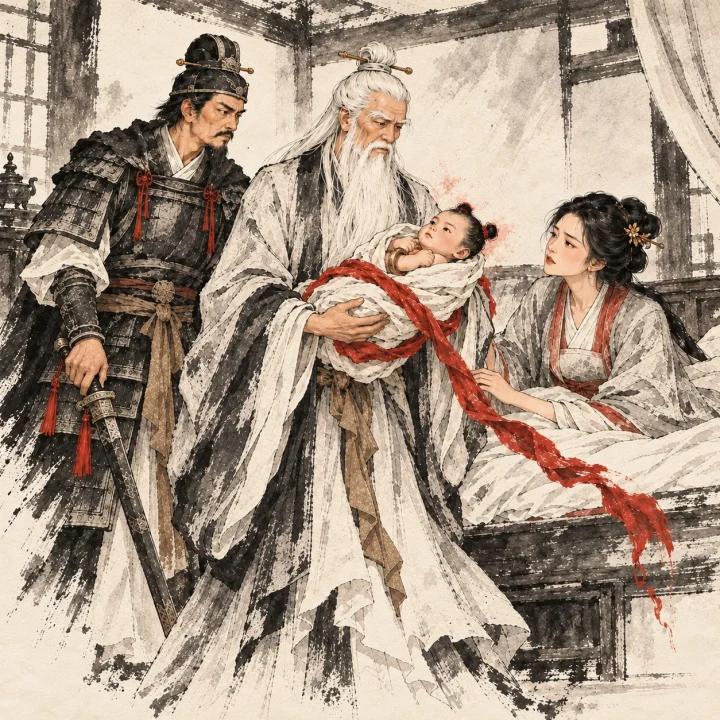
At Chentang Pass, Lady Yin carried her third child for three years and six months. Her husband, the military commander Li Jing, had stopped knowing whether to expect a blessing or a monster. Then, after Lady Yin dreamed that a Daoist placed something in her arms, the birth finally came. The attendants ran out crying that she had delivered a demon. In her chamber, a ball of flesh rolled through red light and strange fragrance. Li Jing drew his sword and split it open. A small boy sprang out and ran across the floor, his face pale, a gold ring around one wrist and a length of red silk wrapped around his body. Li Jing lowered the sword. Whatever else the child might be, he was alive—and unmistakably their son.
The following day, the immortal Taiyi Zhenren arrived from the Golden Light Cave. He named the boy Nezha and accepted him as a disciple, but his prophecy was not comforting: the child had been born beneath a destiny of violence. The gold bracelet was the Universe Ring, or Qiankun Quan. The red silk was the Red Armillary Sash, or Huntian Ling. Both were treasures from Taiyi’s mountain, and both answered the child before he understood what they could do. Nezha therefore grew up inside a contradiction. He was a beloved youngest son and a divine being sent into the human world; a seven-year-old child whose toys could shake palaces and kill immortals.
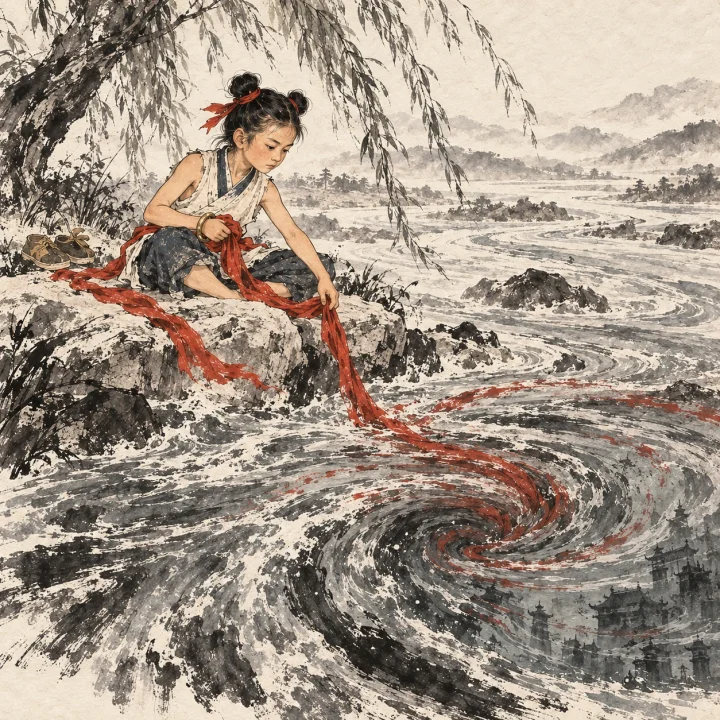
Seven summers passed. One scorching day, Nezha received permission from his mother to walk outside the pass. He stopped beneath the willows beside the Nine-Bend River, stripped off his outer clothes, and sat on a stone to bathe. To cool himself, he dipped the seven-foot Red Armillary Sash into the water. The river turned crimson around it. Each small movement sent force through the estuary: the current rolled, the earth shuddered, and far below the surface the crystal palace of Ao Guang, Dragon King of the Eastern Sea, began to shake. Nezha saw only a bright ribbon in clear water. The dragons beneath him felt their kingdom coming apart.
Ao Guang sent the sea yaksha Li Gen to investigate. The guard rose from the water with blue skin, red hair, tusks, and a great axe, and found a naked child playing beside the river. Insult answered insult. When Li Gen swung, Nezha struck him with the Universe Ring and killed him with a single blow. Ao Guang’s third son, Ao Bing, then rode out through the waves carrying a halberd. He expected to arrest a reckless human boy. Instead he met an opponent who bound him with the Red Armillary Sash and raised the gold ring again. The battle ended almost as soon as Nezha understood how much stronger he was.
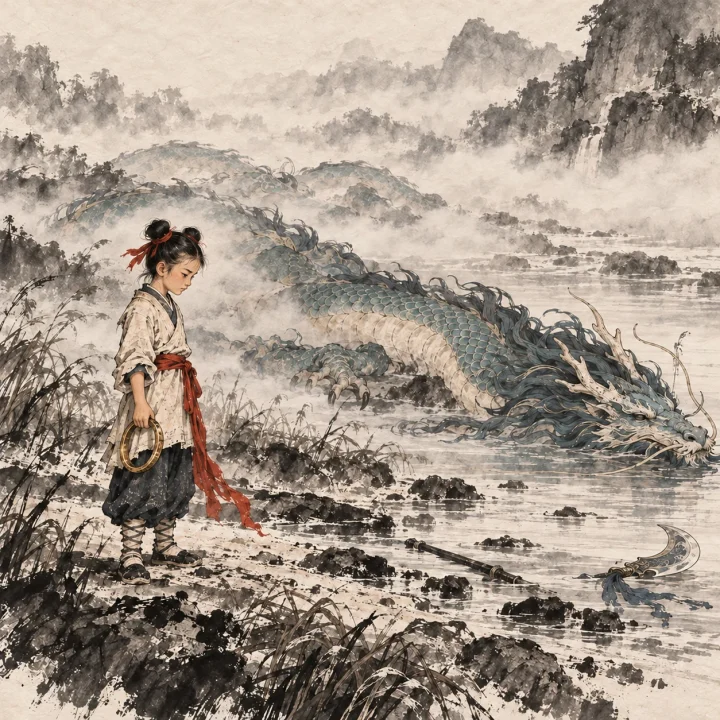
The final blow forced Ao Bing back into his true form: a dragon stretched across the riverbank. Nezha pulled out the dragon’s long tendon, thinking its strength and beauty would make an excellent cord for his father’s armour. He returned home carrying it like a gift. Li Jing stared at the tendon and understood what his son did not. Ao Bing was no wild beast; he was the son of a god charged with clouds and rain. A dead prince meant a grieving father, a celestial accusation, and punishment that could fall upon the entire household. For the first time that day, Nezha saw fear in another person and recognized that his own certainty could not undo what his hands had done.
Ao Guang vowed to report the deaths to Heaven. Nezha tried to stop him and only deepened the quarrel, humiliating the Dragon King at the heavenly gate. Soon the rulers of the four seas arrived at Chentang Pass and seized Li Jing and Lady Yin. Nezha returned to find his parents facing punishment for actions that had been his alone. “One person acts; one person answers,” he said. He offered his own life if the dragons would release them. The sacrifice in Investiture of the Gods is deliberately terrible, but its meaning is clear: Nezha returns flesh to his mother and bones to his father, surrendering the body they gave him so that his debt will not become theirs. The Dragon Kings accept the exchange. His parents live; the child does not.
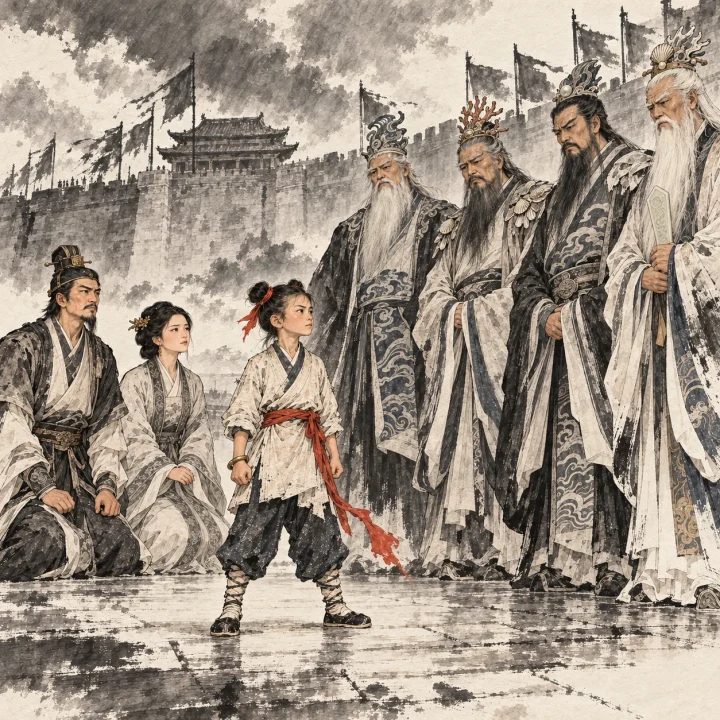
Without a body, Nezha’s spirit drifted back to Taiyi Zhenren. The immortal told him to appear in his mother’s dreams and ask for a temple on Green Screen Mountain. If people offered incense there for three years, the wandering spirit could form a new body. Lady Yin resisted her husband and secretly had the shrine built. Worshippers came. They asked for protection, rain, healing, and good fortune, and the young spirit answered often enough for his reputation to spread. For half a year, incense gave Nezha a place in the human world again. He had been born once from his mother. Now memory, grief, and the belief of strangers were slowly preparing a second birth.
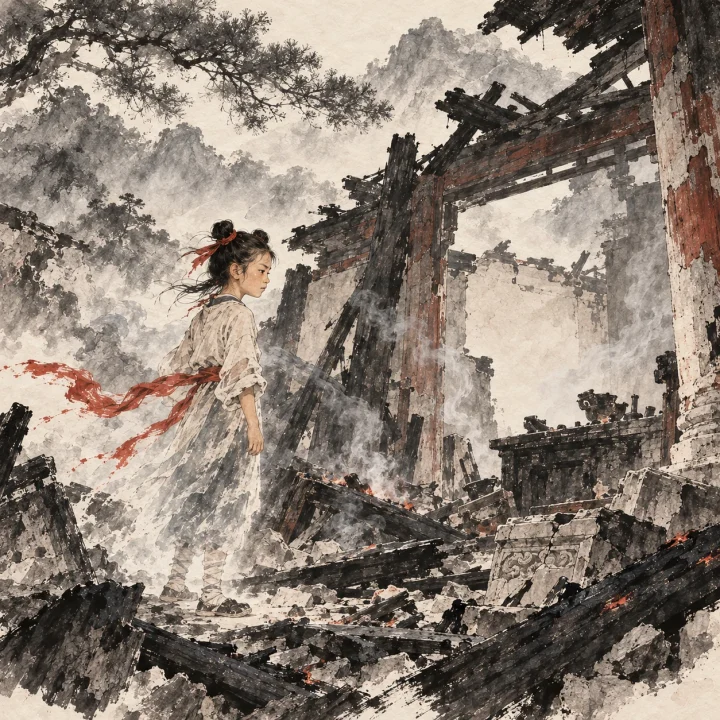
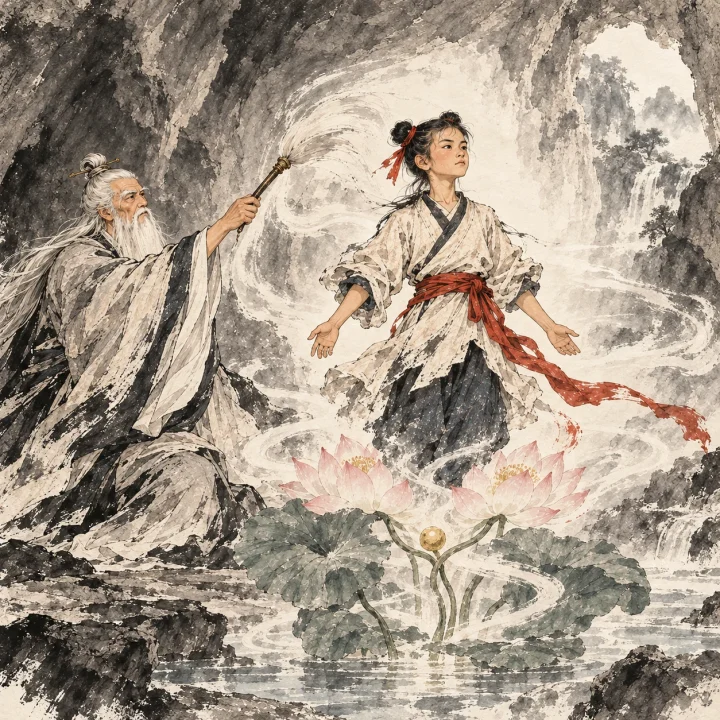
When Li Jing discovered the temple, he saw deception rather than devotion. He smashed the clay image with his whip and ordered the shrine burned. Nezha returned to smoking ruins and found even his borrowed home destroyed by his father. Angry and homeless, he went again to the Golden Light Cave. Taiyi placed two lotus blossoms and three lotus leaves upon the ground, arranged their stems like bones, set a golden elixir at the centre, and drew Nezha’s spirit into them. At his command, the flowers rose and became a living youth: the same bright face and fierce will, now held in a body that owed its substance neither to father nor mother.
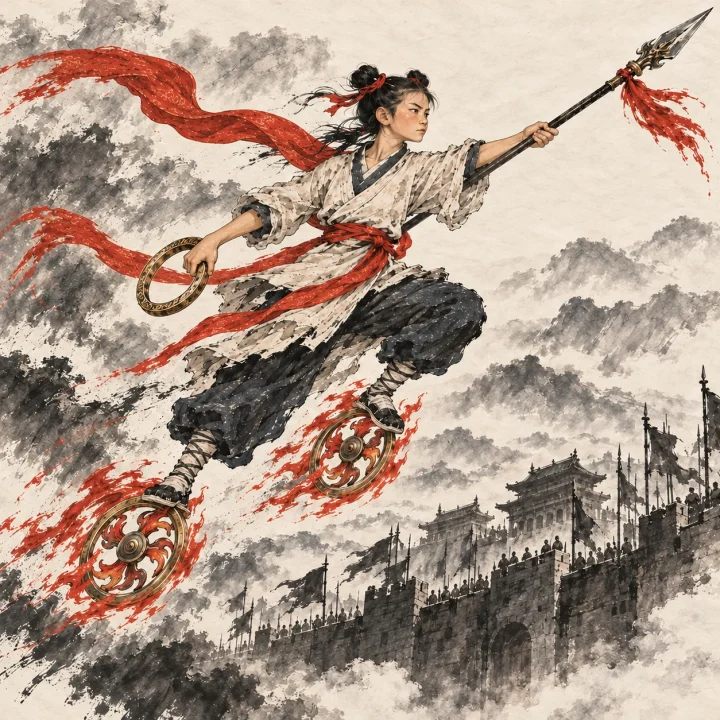
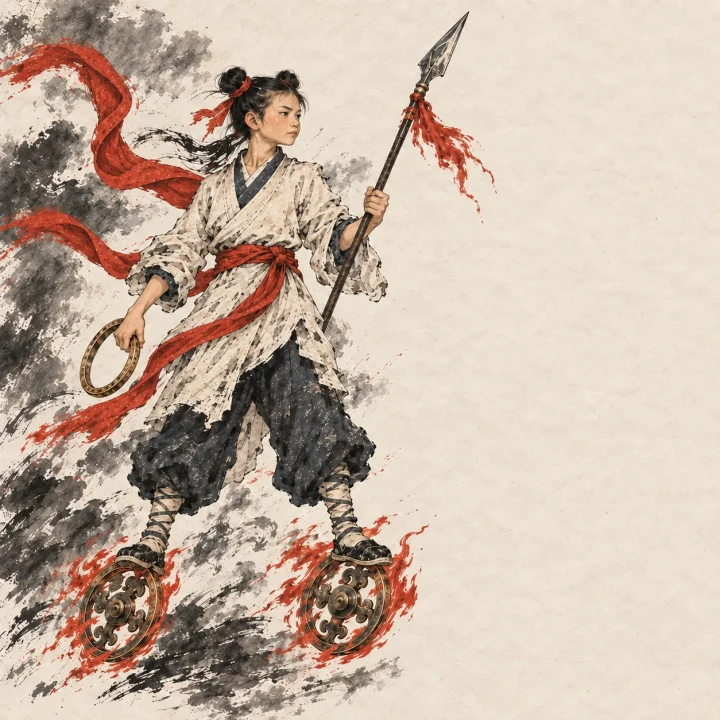
Taiyi taught the reborn Nezha to use the Fire-Tipped Spear and gave him a pair of Wind-Fire Wheels. The Universe Ring and Red Armillary Sash returned to his side. Armed with a new body and old anger, Nezha flew back toward Chentang Pass and pursued Li Jing. Rebirth had freed him from mortality, but it had not made him calm, forgiving, or fully wise. Other immortals intervened, and the Daoist master Randeng eventually gave Li Jing a golden pagoda capable of restraining his son. The father and child stopped trying to destroy one another, although the story never pretends that obedience instantly healed what lay between them.
Nezha later fought beside the forces that overthrew the Shang dynasty, becoming one of the youthful divine warriors of Investiture of the Gods. In temples and popular tradition, he continued to grow beyond the novel: the Third Lotus Prince, a protector, a commander of divine troops, and an eternally young god whose power travels on rings of fire. Yet the lotus body remains the heart of his story. Nezha’s first life gives him strength without proportion; his death makes him answer for its cost; his second birth gives him another chance to decide what that strength will become. This retelling follows Chapters 12–14 of the Ming-dynasty novel. Older religious traditions and later adaptations tell parts of his life differently, but they return again and again to the child who could not remain inside the form the world first gave him.
- Mandarin: Nǎzhā
- Born after three years and six months
- Reborn in a lotus body
- Universe Ring · Red Armillary Sash
- Fire-Tipped Spear · two Wind-Fire Wheels
- Source: Investiture of the Gods


